
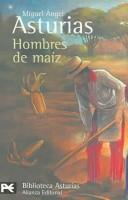
Men of Maize
Miguel Ángel Asturias · 1899–1974 · Guatemala
Originally Hombres de maíz (Spanish) · translated by Gerald Martin
Why it matters
Mayan myth and revenge unfold across five interlocking tales as maize farmers' sacred crop is seized for profit-driven cultivation. Asturias's hardest, strangest book: hallucinatory even by El Señor Presidente's standards.
At a glance
Interlocking tales, invented syntax, and dense Mayan myth make it Asturias's most demanding work.
Deep dive
A novel built less like a plot than like a myth cycle — why its five interlocking tales refuse to add up to one story, and why that refusal is the point.
Written for readers who have finished the book. No plot recap, and nothing here is safe to read first.
Themes & symbolism
The central wound is a violation of use: maize grown by the indigenous communities of the novel as sacred subsistence, planted to feed a family and to honor a covenant with the land, versus maize grown by ladino outsiders as a slash-and-burn cash crop, which scorches the same soil for profit with no ritual accounting at all. Asturias treats this not as a simple colonial-economics dispute but as a cosmological injury — the land in this book is sentient, kin to the people who work it correctly, and the profiteers' burning fields register as an assault on a living relative, not just a resource. That's why the retribution that follows isn't legal or even strictly military; it's curse, illness, and metamorphosis, the forms of justice available to a worldview in which humans, animals, and the earth are continuous with one another.
The recurring image of people transforming into or being shadowed by their nahual — an animal double or spirit-guardian — runs through all five sections and does real structural work: it's how the novel represents grief, guilt, and searching without resorting to psychological interiority in the European sense. A man who has lost his wife doesn't merely mourn her, he becomes a firefly hunting for her in the dark, or a coyote loping across the land in her place, because in the Mayan-inflected cosmology Asturias is working in, the boundary between human suffering and animal form is porous rather than metaphorical.
Asturias's Hardest Book
Asturias trained partly as an anthropologist in Paris under Georges Raynaud, working on a French translation of the Popol Vuh, the sacred K'iche' Maya text — and Men of Maize is the novel where that scholarship overtakes his fiction most completely. Where El Señor Presidente is a nightmarish but recognizably linear political satire of dictatorship, this book abandons linear plot almost entirely in favor of a structure closer to oral myth-cycles: repeating motifs, incantatory, hallucinatory prose dense with Mayan cosmology and Guatemalan dialect, and a refusal to explain its own logic to a reader expecting Western narrative causality. It was, and still is, the least read of his major works precisely because of that difficulty — even sympathetic critics have called it his most demanding book — but it's also the one where his ambition to write a genuinely indigenous American novel, rather than a European novel set in the Americas, is most fully realized. The 1967 Nobel committee's citation for Asturias leaned on his 'work deeply rooted in the national traits and traditions of Indian peoples,' and this novel is the clearest evidence of what that meant in practice.
The last seal: what actually happens, and why it lands the way it does.
The ending, explained
Men of Maize deliberately resists the kind of ending a summary can deliver, and that resistance is the novel's whole argument. Gaspar Ilóm, the indigenous leader who opens the book resisting the maize-burners, is poisoned by informers bribed by the profiteers — but Asturias narrates his death as an absorption back into the land he defended rather than a defeat, and the curse his sorcerer allies lay on the informers doesn't resolve anything, it starts a chain: their families sicken and die out across generations, echoes of the original violation rippling forward with no single character left alive to receive final justice or closure. The book's later sections — following Machojón, then the blind Goyo Yic, then the mail carrier Nicho Aquino, each of them searching for a vanished wife and each of them shadowed by an animal transformation — don't converge on one climax; they layer the same wound (loss, searching, metamorphosis) across new generations and new names, the way a myth cycle repeats its structure rather than resolving its plot. That's a deliberate formal choice: Asturias is imitating Mayan oral narrative, in which land, violation, and consequence recur rather than conclude, and a conventional tidy ending would betray the cosmology the novel is trying to embody. The maize keeps being planted, burned, and replanted; the land keeps outliving the men who fight over it. Refusing closure is how the book insists that this isn't a finished historical grievance but a cycle still turning.
Where to go next
 Miguel Ángel Asturias · 1946El Señor PresidenteLvl 8Slow burn
 Augusto Roa Bastos · 1974I, the SupremeLvl 9Slow burn
 Gabriel García Márquez · 1967One Hundred Years of SolitudeLvl 6Medium pace
 Elena Garro · 1963Recollections of Things to ComeLvl 7Slow burn
 Alejo Carpentier · 1949The Kingdom of This WorldLvl 5Medium pace
 Juan Rulfo · 1955Pedro PáramoLvl 7Slow burn