
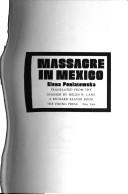
Massacre in Mexico
Elena Poniatowska · b. 1932 · Mexico
Originally La noche de Tlatelolco (Spanish) · translated by Helen R. Lane
Why it matters
Hundreds of voices assembled into an account of the 1968 killing of student protesters at Tlatelolco. Poniatowska raises testimonio to the pitch of collective elegy: journalism as literature and act of resistance.
At a glance
Collaged testimony from hundreds of voices requires assembling a fragmented mosaic account.
Deep dive
A book with no narrator and hundreds of witnesses — how Poniatowska turned raw testimony into a form of literature, and what that form is built to do that a conventional history couldn't.
Written for readers who have finished the book. No plot recap, and nothing here is safe to read first.
Themes & symbolism
Poniatowska's method is collage as argument: rather than write a single authoritative account, she assembles the voices of students, mothers, soldiers, bystanders, and officials into a mosaic with no controlling narrator, so the book's very form embodies the democratic plurality the Mexican state was trying to crush at Tlatelolco. Where an official version speaks in one unified voice claiming to be neutral, Poniatowska's version speaks in hundreds of voices that openly contradict one another on details — how many shots, how many dead, who fired first — and the discrepancies aren't a flaw in the reporting, they're the point: this is what truth sounds like when it hasn't been laundered into a single sanctioned story.
The original Spanish title, La noche de Tlatelolco, layers the 1968 massacre onto the site's older name: the Plaza de las Tres Culturas, built where Aztec ruins, a colonial church, and modern apartment blocks stand literally on top of one another as a monument to Mexican history's successive conquests. The massacre becomes a fourth layer of state violence inscribed on the same ground, and Poniatowska's testimonio insists on making that continuity visible rather than letting the event be filed away as an isolated, forgivable incident. Grief in the book is overwhelmingly maternal and domestic — mothers searching morgues and hospitals for children who vanished that night — which keeps the massacre from ever becoming an abstraction of politics; it stays, insistently, a matter of specific bodies and specific names.
October 2, 1968
Ten days before Mexico City opened the 1968 Summer Olympics to the world as a showcase of national stability, government forces — including the plainclothes Batallón Olimpia — opened fire on a student demonstration in the Plaza de las Tres Culturas, killing an unknown number of protesters, likely in the hundreds, though the Díaz Ordaz government's official count claimed barely two dozen and insisted the students had fired first. The regime moved fast to bury the story: censoring the press, jailing student leaders, and proceeding with the Olympics eleven days later as though nothing had happened. Poniatowska, already an established journalist, spent years afterward tracking down survivors, witnesses, and relatives and stitching their testimony into this book, which appeared in 1971 as one of the first major cracks in the PRI's decades-long control of the national narrative — and helped establish testimonio as a serious literary form in Latin America, the mode later used by figures like Rigoberta Menchú to put eyewitness voice, rather than novelistic invention, at the center of politically urgent literature.
The last seal: what actually happens, and why it lands the way it does.
The ending, explained
Because this is documentary testimonio rather than plotted fiction, the book doesn't end with resolution — nobody is held accountable within it, and no official apology arrives. What closes the book instead is sheer accumulated weight: page after page of names, ages, occupations, last-seen locations, offered without editorial summary, so that the reader is left holding the same unresolved grief the mothers and survivors are holding. That refusal of narrative catharsis is itself the book's final argument — the state got its silence and its Olympics, and literature's only available counter-move was to make forgetting impossible by insisting, testimony by testimony, that these were specific people with specific faces, not a rounding error in an official death toll. The massacre wasn't solved by the book; it was simply, permanently, refused erasure.
Where to go next
 Elena Poniatowska · 1969Here's to You, Jesusa!Lvl 5Medium pace
 Reinaldo Arenas · 1969HallucinationsLvl 7Fast paced
 Fernando del Paso · 1977Palinuro of MexicoLvl 9Slow burn
 Jorge Ibargüengoitia · 1977The Dead GirlsLvl 4Fast paced
 Sergio Pitol · 1996The Art of FlightLvl 7Slow burn
 Mario Vargas Llosa · 1963The Time of the HeroLvl 6Medium pace