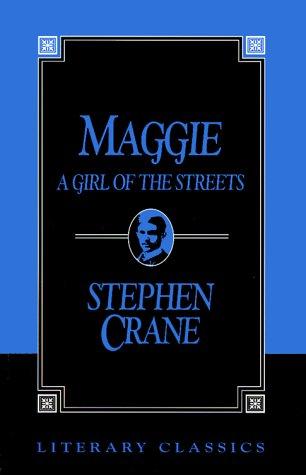
Maggie: A Girl of the Streets
Stephen Crane · 1871–1900 · United States
Why it matters
A Bowery tenement girl is destroyed by poverty, an abusive family, and a seducer's empty promises. Crane's self-published debut, too grim for commercial publishers, became a founding text of American literary naturalism.
At a glance
Short and plainly told, though its slang-heavy dialogue and irony take some acclimation.
Deep dive
A Bowery tenement girl finds one door out of her family's violence, through a bartender whose confidence reads to her like sophistication, and Crane spends the rest of the book showing exactly what that door actually opens onto.
Written for readers who have finished the book. No plot recap, and nothing here is safe to read first.
Themes & symbolism
Maggie Johnson grows up amid her parents' drunken brawling in a Bowery tenement, her brother Jimmie absorbing and reproducing the same casual brutality as simply how the world works, and Crane, who self-published the novel under a pseudonym in 1893 after publishers balked at the subject, builds Maggie's arc around Pete, a bartender whose cheap gallantry and confident manner strike a girl starved of any gentleness as sophistication itself. Crane's prose describes the tenement's inhabitants with an almost entomological detachment, environment functioning as a kind of fate no character in the book is equipped to argue with.
Once Pete seduces and discards her, Maggie's own family, whose violence and neglect produced her vulnerability in the first place, casts her out as ruined, her mother Mary performing the loudest outrage of anyone in the building despite having offered Maggie no protection at all. Crane's target is never Maggie's virtue but the machinery of judgment surrounding her: a slum culture that manufactures its own victims and then punishes them for exactly the fall it made close to inevitable.
Mary's Performance of Grief
The novel's savage final scene stages Mary, drunk and surrounded by sympathetic tenement neighbors, delivering a theatrical eulogy insisting Maggie was always a good girl, and Crane renders the scene with such exact, cold mimicry of maudlin sentiment that it lands as the book's harshest indictment, worse in its way than anything Pete ever does to Maggie directly.
Crane's Dialect as Documentary Method
Crane transcribes the Bowery's speech phonetically throughout, Jimmie's and Mary's slurred, profanity-laced dialogue rendered with a linguistic precision that scandalized genteel reviewers as much as the subject matter did, and the choice functions as its own argument: refusing to smooth the tenement's language into standard prose keeps the novel from softening its characters into sentimental victims, insisting instead on exactly how they actually sounded to each other and to themselves. Crane paid for the first printing himself under the pseudonym Johnston Smith after commercial publishers declined it, and the book sold barely a handful of copies in its lifetime, its reputation built almost entirely in retrospect once naturalism became a movement with a name attached to it.
The last seal: what actually happens, and why it lands the way it does.
The ending, explained
Abandoned once Pete's interest shifts to a rival named Nell, and turned away by her own mother and brother, Maggie descends over a handful of compressed chapters into street prostitution, which Crane renders through an increasingly abstract, almost impressionistic sequence of anonymous men and city blocks rather than direct narration. Her final walk toward the docks and the river implies rather than states her death, the text withholding even the dignity of depicting it outright. The novel's true ending, though, is Mary's wake days later, unchanged, already rewriting her daughter's short life into a story the neighborhood can bear to repeat, Crane's bleakest joke being how quickly the machinery that destroyed Maggie closes back over the gap she leaves.