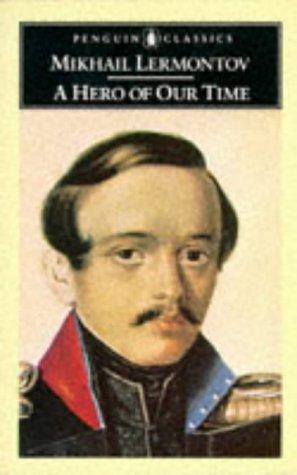
A Hero of Our Time
Mikhail Lermontov · 1814–1841 · Russia
Originally Geroy Nashego Vremeni (Russian)
Why it matters
Five interlinked tales orbiting Pechorin, a bored, brilliant nobleman who wrecks every life he touches and can't say why. Russia's first great psychological novel, and the template for every restless, purposeless 'superfluous man' who followed him.
At a glance
Nonlinear, multi-narrator structure complicates an otherwise brisk, accessible prose style.
Deep dive
Five stories told out of order by three different narrators close in on the same restless nobleman, and what Lermontov gains by making the reader assemble him backward.
Written for readers who have finished the book. No plot recap, and nothing here is safe to read first.
Themes & symbolism
The published order runs Bela, Maksim Maksimych, Taman, Princess Mary, The Fatalist, while the events themselves run roughly the reverse of that, so a reader meets Pechorin first through an old officer's admiring, uncomprehending account of him kidnapping a Circassian girl, then through a brief external glimpse of the man himself grown cold and evasive, and only then through Pechorin's own journal, written years earlier, in his own voice. Lermontov builds a psychological case file rather than a chronology, adding a layer of interpretation, Maksim Maksimych's, the frame narrator's, before ever letting Pechorin explain himself.
In Princess Mary, Pechorin's own diary, he courts Mary Ligovskaya not because he wants her but because winning her wounds his rival Grushnitsky more precisely than any direct confrontation could, and he records his own manipulations with a clinical detachment that never once claims regret. Lermontov calls him a product of his age directly in the preface: an intelligent, capable man with no legitimate outlet for his energy under Nicholas I's autocracy, who turns the people around him into an experiment because the state has left him nothing else to govern. Pechorin is the founding portrait of the 'superfluous man', the type Turgenev, Goncharov, and Chekhov kept rewriting for the rest of the century.
The Caucasus itself, its mountains, its Circassian and Chechen villages under Russian occupation, supplies Lermontov's exoticized backdrop and also a running irony: a man bored with his own civilization looks for meaning in a war zone where actual people, Bela's family among them, pay the cost of his search for sensation.
Why the Diary Comes Last
Placing Pechorin's own words after two outside accounts of him, Maksim Maksimych's story and the frame narrator's brief meeting with him, means the reader already has a fixed image of Pechorin's coldness before his journal has any chance to earn sympathy on its own terms. Lermontov uses that sequence to block the usual effect of first-person narration, where interiority tends to generate identification: here the interiority arrives discredited in advance, so Pechorin's wit and self-awareness in Princess Mary and The Fatalist read as symptoms of his condition rather than as an invitation to root for him.
The last seal: what actually happens, and why it lands the way it does.
The ending, explained
By the time the reader reaches Pechorin's journal, the book has already reported, through Maksim Maksimych in the second story, that Pechorin died on the road back from Persia, so The Fatalist's climax, Pechorin's wager with the nihilist officer Vulich over whether a man's death is fixed in advance, plays out under a foreknown result. Vulich survives a spun-chamber gunshot to the head that should have killed him on the spot, seeming to prove predestination, then is killed hours later by a drunk Cossack in an entirely unrelated accident, which Pechorin treats less as tragedy than as data for his own theory of fate. Pechorin closes the book testing that same theory against his own life, disarming the Cossack barricaded in a hut, in a scene that reads as reckless courage or as a man already treating himself as dead. Lermontov gives no tidy answer on predestination; he gives a man who has decided the answer doesn't change how he'll act, and the reader already knows how little time that man had left.