
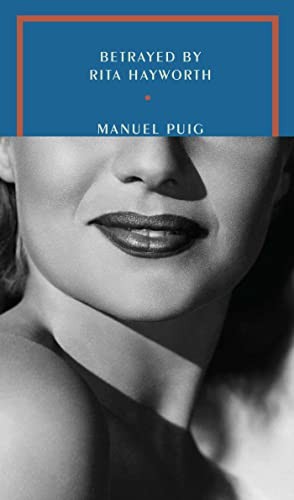
Betrayed by Rita Hayworth
Manuel Puig · 1932–1990 · Argentina
Originally La traición de Rita Hayworth (Spanish) · translated by Suzanne Jill Levine
Why it matters
A boy's provincial Argentine childhood is narrated entirely through overheard dialogue, letters, and the Hollywood films that shape his imagination. Puig's debut announced his lifelong fascination with pop culture as the texture of ordinary consciousness.
At a glance
Narrated entirely through overheard dialogue and fragments, with no conventional narrator.
Deep dive
How a small-town Argentine childhood gets told entirely through other people's voices, letters, and gossip, and why the boy at its center barely narrates a page of his own story.
Written for readers who have finished the book. No plot recap, and nothing here is safe to read first.
Themes & symbolism
Puig strips out the narrator so completely that most readers don't notice until well into the book that no one is actually telling this story. Toto's mother Mita gossips with her sisters, his father Berto broods in a private monologue that never once mentions his son by name, a cousin writes a school composition, a maid rambles through a run-on interior stream, and the sixteen chapters simply lay these fragments side by side, letting a boy's world assemble itself out of everyone else's talk about him rather than his own account. The effect isn't distance. It's closer to eavesdropping on an entire town, provincial Vallejos in the 1930s and '40s, in order to triangulate one child nobody in it is actually watching closely.
Movies are the only vocabulary Toto has for feeling, and Puig treats that fact with total seriousness rather than as childish escapism: Toto narrates his own life in the plots and stars of the films he's seen, measuring his mother's beauty against Norma Shearer, his own loneliness against a heroine's exile, because Hollywood has supplied him with a richer emotional grammar than Vallejos or his own family ever will. What the novel never states outright, and doesn't need to, is what kind of boy pays this much attention to actresses and this little to the masculine roughhousing expected of him. Puig, writing his own thinly disguised childhood, lets the pattern of Toto's attention do the work a confession would do in a lesser book, present in exactly which scenes he replays and which boys he can't stop describing.
A Novel With No One Speaking For It
Kiss of the Spider Woman, Puig's later and more famous novel, is nearly all transcribed dialogue between two men in a cell. Betrayed by Rita Hayworth got there first and went further: letters, a maid's unpunctuated ramble, a girl's diary, an anonymous denunciation, each chapter changing register completely, so the book reads like a town's entire archive of private documents rather than a story anyone chose to tell. Puig had trained as a scriptwriter and worked briefly in Italian film before turning to fiction, and the discipline shows: every chapter is written entirely in the voice of whoever's supposedly producing it, with nothing held back for the reader's convenience.
Provincial Argentina as a Small Machine of Watching
Vallejos runs on gossip the way Hollywood runs on publicity, and Puig keeps drawing that parallel without underlining it: everyone in town is narrating everyone else, checking whose son is turning out strange, whose marriage is failing, exactly the way movie magazines tracked stars' scandals. Toto grows up inside two overlapping surveillance systems, a small town's moral policing and a movie fan's worshipful attention, and never seems to notice the second one is where he actually feels safe. Puig, who left Argentina for Rome and eventually New York, wrote the book as an adult finally free of that watching, which may be why it renders the town's claustrophobia so exactly, with real affection alongside the suffocation.
Where to go next
 Manuel Puig · 1976Kiss of the Spider WomanLvl 6Fast paced
 Fernando del Paso · 1977Palinuro of MexicoLvl 9Slow burn
 José Donoso · 1970The Obscene Bird of NightLvl 9Slow burn
 Sergio Pitol · 1996The Art of FlightLvl 7Slow burn
 Elena Poniatowska · 1971Massacre in MexicoLvl 5Medium pace
 Reinaldo Arenas · 1969HallucinationsLvl 7Fast paced