
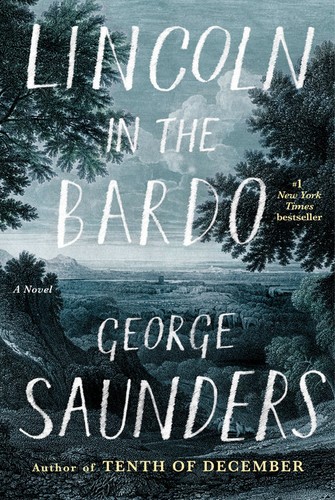
Lincoln in the Bardo
George Saunders · b. 1958 · United States
Why it matters
A grieving Lincoln visits his dead son's crypt, surrounded by the chattering ghosts who refuse to move on. Saunders's Booker winner, assembled entirely from voices, is a séance about love, loss, and letting go.
At a glance
A polyphonic chorus of ghost-narrators and collaged historical fragments require active assembly.
Deep dive
A graveyard full of the dead who refuse to admit they're dead — until a grieving president wanders in and, for one night, they get to speak through him.
Written for readers who have finished the book. No plot recap, and nothing here is safe to read first.
Themes & symbolism
Saunders builds the novel entirely out of collage: invented ghost testimony set against a chorus of real and fabricated historical excerpts about Lincoln, contradicting each other on the color of the moon that February night as readily as on matters of substance. The effect isn't unreliability for its own sake — it's an argument that history is always assembled this way, out of mismatched, self-interested fragments, and that a novel admitting as much is more honest than one pretending to omniscience.
The bardo itself, the Tibetan Buddhist-inflected waystation where Saunders's ghosts are stuck, is essentially denial given architecture: the dead call their coffins 'sick-boxes' and insist they'll return to their old lives any day, and the volcanic burst of light and sound that finally releases a spirit — the 'matterlightblooming phenomenon' — only comes once a ghost stops lying to itself about what it is. Willie's death forces exactly that reckoning onto Lincoln above ground, his paralyzing grief for one child colliding with his responsibility for a war killing thousands of other people's children, a scale problem the novel refuses to resolve neatly. Hans Vollman, killed before consummating his marriage, Roger Bevins III, who slit his wrists over unrequited love and now sprouts extra eyes and hands craving the sensory world he abandoned, and the Reverend Everly Thomas, paralyzed by terror of a judgment he's certain awaits him, each dramatize a distinct species of unfinished longing keeping the dead tethered to the ground.
A Segregated Graveyard, a Democracy of Voices
Oak Hill Cemetery's dead are stratified exactly like the living nation outside its gates: a walled-off, gated area for the poor and enslaved dead sits apart from the well-tended plots of the prosperous, and the novel's most pointed scenes let those excluded voices — furious, funny, unresisting of nothing — needle the self-important white ghosts who dominate the main narrative. Saunders uses the chorus form to build something like a jury of the dead passing judgment on the republic Lincoln is trying to save, inequality persisting past the grave as pointedly as it does across the Mason-Dixon line the war is being fought over.
A Short-Story Writer's Novel
Saunders spent nearly three decades as one of America's most admired short-story writers before attempting a first novel, and the book's polyphonic collage — hundreds of short, attributed fragments rather than continuous prose — reads as that training scaled up rather than abandoned: each ghost gets a compressed, story-sized voice, comic and specific, before the chorus effect takes over. The gamble paid off unusually visibly, winning the Booker Prize and confirming that Saunders's tonal signature — grief and slapstick sharing the same sentence — could sustain novel length. The Civil War setting, with its unprecedented, industrialized death toll, gives that signature its highest possible stakes: an entire nation, like Lincoln himself, trying to process losses too large to fully feel one at a time.
The last seal: what actually happens, and why it lands the way it does.
The ending, explained
Lincoln returns to the crypt and holds his son's body, and in that contact several ghosts — Hans Vollman, Roger Bevins III, and others — discover they can enter and briefly inhabit him, experiencing his grief and his resolve to see the war through directly rather than at a remove. It's through this literal merging that they finally grasp what their own unfinished business has cost them, and several, including eventually Willie himself, undergo the matterlightblooming release and move on. Lincoln leaves the crypt at dawn changed, carrying both his grief and a clarified sense of the war's necessity back into the world. The ghosts left behind return to their denials, but the reader has watched the alternative: letting go, however late, is still possible.
Where to go next
 George Saunders · 2013Tenth of DecemberLvl 5Fast paced
 Kurt Vonnegut · 1969Slaughterhouse-FiveLvl 5Fast paced
 Charles Yu · 2020Interior ChinatownLvl 5Fast paced
 John Irving · 1978The World According to GarpLvl 4Fast paced
 Percival Everett · 2001ErasureLvl 6Fast paced
 Andrea Barrett · 1996Ship Fever and Other StoriesLvl 5Medium pace