
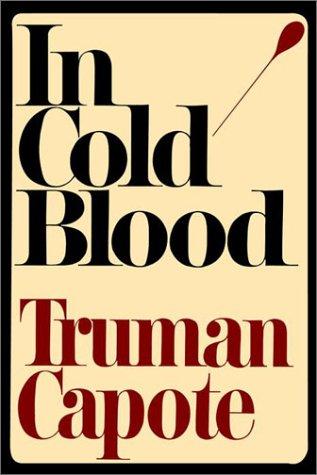
In Cold Blood
Truman Capote · 1924–1984 · United States
Why it matters
Six years of research into a Kansas farmhouse quadruple murder become a narrative with a novelist's total command of scene, character, and dread. The book that invented, or at least perfected, the nonfiction novel.
At a glance
Journalistic clarity, but braided timelines across multiple perspectives.
Deep dive
How Capote builds a true-crime account with the architecture of a novel, and what it costs him to make you feel two ways at once about the men who did it.
Written for readers who have finished the book. No plot recap, and nothing here is safe to read first.
Themes & symbolism
Capote's structural gambit is to cut between the Clutters' last ordinary day and Perry Smith and Dick Hickock's approach to it, so that two Americas — the industrious, church-going, prosperous Kansas of Herbert Clutter and the drifting, institutionalized, damaged America that produced his killers — are shown converging on the same night without either side knowing it. The book's real subject isn't the murder so much as the gap between them: how a country that produces both the Clutters and the men who kill them can pretend those are two unrelated stories, when the novel keeps insisting, structurally, that they're one story told from opposite ends.
Perry Smith gets the interiority the genre would normally reserve for a protagonist — the abusive childhood, the motorcycle accident, the drawings and dreams of a golden bird that rescues him — while Dick Hickock stays comparatively flat, a small-time con man with none of Perry's reflective depth. That imbalance is Capote's most debated authorial choice: it produces real sympathy for Perry without ever excusing what he did, and it means the book's emotional center of gravity sits, uncomfortably, with the killer rather than the family he destroyed.
Six Years, One Relationship, and the 'Nonfiction Novel'
Capote traveled to Holcomb within days of the November 1959 murders with Harper Lee assisting as researcher, and stayed with the case for six years — through the killers' capture in Las Vegas (tipped off by a former cellmate of Hickock's, Floyd Wells, who'd once worked for Clutter and remembered a rumored safe that didn't exist), the trial, the years of appeals, and the 1965 hangings at Lansing. He conducted thousands of pages of interviews and claimed near-total recall instead of notes or recordings, a method later scholars have shown produced invented dialogue and reshaped scenes — the book's greatest technical achievement and its most contested ethical liability sit in the same sentence. Capote's relationship with Perry Smith, whom he visited repeatedly on death row and by most accounts came to feel something like love for, is the open secret behind the book's asymmetric sympathies: he needed the executions to happen to finish his book, and by his own later admission never fully recovered from what that meant. He called the result a 'nonfiction novel,' a genre label the book effectively invented and that true crime, New Journalism, and later podcasts have been arguing with ever since.
The last seal: what actually happens, and why it lands the way it does.
The ending, explained
Smith and Hickock are hanged in April 1965 at the Kansas State Penitentiary, five years after the murders, following appeals that Capote — who by then wanted the case closed as much as anyone — found himself simultaneously funding his subjects' lawyers to prolong and privately dreading the end of. Capote doesn't end on the gallows, though. The book's true closing movement is a quiet coda: Detective Alvin Dewey, who led the investigation, visits the Clutter family's graves and encounters Sue Kidwell, Nancy Clutter's closest friend, now grown, in the same cemetery. Nothing dramatic happens — they talk briefly about ordinary things, she walks off across the wheat fields — but the scene's flatness is the point. Life in Holcomb has simply continued past the trauma, indifferent to the six years of narrative Capote spent inside it, which is a more devastating final note than any courtroom or gallows scene could supply.
Where to go next
 Truman Capote · 1958Breakfast at Tiffany'sLvl 3Medium pace
 Patricia Highsmith · 1955The Talented Mr. RipleyLvl 4Fast paced
 Friedrich Dürrenmatt · 1958The PledgeLvl 5Fast paced
 Norman Mailer · 1948The Naked and the DeadLvl 6Fast paced
 J. D. Salinger · 1951The Catcher in the RyeLvl 3Fast paced
 Mavis Gallant · 2002Paris StoriesLvl 5Medium pace