
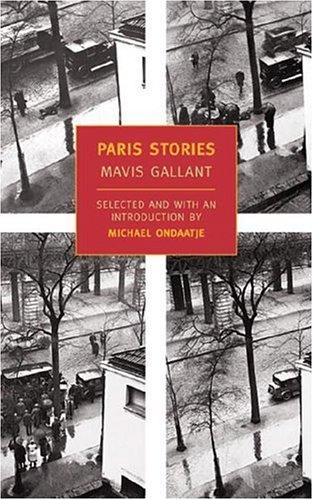
Paris Stories
Mavis Gallant · 1922–2014 · Canada
Why it matters
The definitive NYRB Classics gathering of six decades' New Yorker stories about refugees, war orphans, and expatriates adrift across postwar Europe, rendered with a cool, exact irony that never asks for pity. The career-spanning introduction to one of the short story's great, underread masters.
At a glance
Elliptical, understated narration and shifting European settings reward patient, attentive reading.
Deep dive
What happens when six decades of a Canadian expatriate's magazine work get reordered by obsession instead of by year, and the case that reordering makes for her as a major postwar stylist.
Written for readers who have finished the book. No plot recap, and nothing here is safe to read first.
Themes & symbolism
Paris Stories draws its contents from five decades of Mavis Gallant's fiction for The New Yorker, arranged by the novelist Michael Ondaatje not by original publication date but by the through-line of Gallant's obsessions: refugees settling into countries that never wanted them, war orphans raised by relatives who resent the obligation, expatriates who have been away from home so long that going back has stopped being an option. The Moslem Wife follows Netta Asher, an Englishwoman who runs her family's hotel on the French Riviera and marries her cousin Jack less for love than for the hotel's sake, an arrangement that survives the German occupation, Jack's long wartime disappearance, and his eventual infidelities mostly because Netta never asked it to be more than that.
The Ice Wagon Going Down the Street turns the same rootlessness inward: Peter Frazier, a failed Canadian civil servant drifting from Geneva to Toronto and back, spends the story replaying a single missed connection with a colleague named Agnes Brusen, a plain, serious woman he mocked at a party and never forgave himself for mocking, Gallant's exactness lying in how little Peter actually understands about why the memory still stings decades later.
The volume closes with the Linnet Muir stories, Gallant's only extended return to her own life: a young woman comes back to wartime Montreal to work as a journalist, chafing against a city still governed by parish priests and a mother she has spent years avoiding. Reading straight through makes Gallant's consistency visible in a way scattered magazine appearances never could, the same cool, unsentimental distance applied across sixty years and three continents of people who have all, one way or another, stopped belonging anywhere.
Netta Asher's Marriage That Never Needed Love
Netta keeps the hotel running through the occupation almost by force of will, and when Jack finally reappears after the war, changed and unfaithful, Gallant refuses her the satisfaction of righteous anger: Netta had never staked her sense of herself on Jack's fidelity in the first place, only on the hotel surviving, which makes the marriage's real durability, not its warmth, the story's actual achievement.
Ondaatje's Chronology Over Gallant's
By sequencing the stories thematically instead of by the decade each first ran in The New Yorker, Ondaatje's editorial choice becomes a critical argument in its own right, steering a reader toward Gallant's recurring obsessions rather than toward her development as a writer, and making a case, story by story, for a career most American readers had never encountered as a whole.
Where to go next
 Sherwood Anderson · 1919Winesburg, OhioLvl 3Medium pace
 Alice Munro · 2012Dear LifeLvl 5Medium pace
 Peter Taylor · 1986A Summons to MemphisLvl 5Slow burn
 Raymond Carver · 1983CathedralLvl 4Medium pace
 Richard Yates · 1961Revolutionary RoadLvl 4Medium pace
 John Cheever · 1978The Stories of John CheeverLvl 4Medium pace