
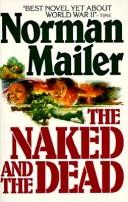
The Naked and the Dead
Norman Mailer · 1923–2007 · United States
Why it matters
A platoon on a Pacific island endures combat, but the deeper battle is with their own sadistic command structure. Mailer's debut, written at twenty-five, became the era's essential American war novel.
At a glance
Large ensemble cast and interwoven flashback 'Time Machine' sections.
Deep dive
Two theories of how history actually gets made — one man's will imposed by force, one man's mastery of grand strategy — go to war with each other on the same island, and neither one wins the way it expects to.
Written for readers who have finished the book. No plot recap, and nothing here is safe to read first.
Themes & symbolism
Mailer builds the platoon as a cross-section of American class and ethnic resentment — a Boston Brahmin lieutenant, a Texas oil heir, a Jewish intellectual, a Mexican-American, a Southern anti-Semite — and lets the real war be the one they wage on each other, which Mailer clearly regards as more revealing of America than anything happening against the Japanese. General Cummings and his aide, Lieutenant Hearn, spend their scenes together in extended philosophical duels about power: Cummings argues, with real conviction, that history is authored by men willing to impose their will without sentiment, a proto-fascist theory of command he's applying to the campaign in real time. Hearn, appalled and fascinated in equal measure, becomes the novel's liberal conscience, and his failure to effectively resist Cummings' worldview is as damning as anything the enlisted men do to each other.
Sergeant Croft is the novel's id, a man who has replaced every other motive with pure will-to-dominate, and his fixation on personally conquering Mount Anaka — a goal with no military value whatsoever — makes him Cummings' unacknowledged double: the theory of command stripped of its intellectual justification and revealed as simple sadism. Mailer's structural device, the interspersed 'Time Machine' biographical interludes for each soldier (lifted straight from Dos Passos), keeps insisting that none of these men arrived in the jungle as blank slates — the war just gives their prewar American selves, class hatreds and family wounds included, a battlefield to finish playing out on.
Mailer at Twenty-Five
Mailer served in the Pacific as an infantryman and clerk-typist with the 112th Cavalry in the Philippines, saw limited combat, and started drafting this novel almost immediately after his 1946 discharge, publishing it in 1948 at twenty-five to enormous acclaim and sales that made him instantly, and permanently, a public literary figure — a level of fame he'd spend the rest of his career alternately chasing and resenting. The novel's naturalist pedigree is deliberate: Mailer was reading Dos Passos and Tolstoy while writing it, and the book's ambition to render an entire social order through one military campaign owes more to War and Peace than to any combat memoir. Critics have long noted the irony that Mailer, later famous for cultivating his own outsized macho persona, wrote his debut as an anatomy of exactly that kind of domination-hungry masculinity, without ever quite deciding whether he was diagnosing it or half in love with it.
The last seal: what actually happens, and why it lands the way it does.
The ending, explained
The novel's climax is a joke on both of its power theorists. Croft, having taken over the platoon's reconnaissance patrol after Hearn is killed leading it, drives the exhausted, mutinous men toward his private obsession with summiting Mount Anaka; when they blunder into a hornet's nest partway up, the patrol disintegrates into panic and open defiance, and Croft's authority — built entirely on fear rather than loyalty — collapses along with the mission, the summit abandoned in chaos just short of the top. Simultaneously, back at headquarters, Cummings' meticulously planned campaign to break the Japanese line is rendered moot: while he's away consulting with a naval commander to secure more artillery support, the bumbling, mediocre staff officer Major Dalleson, left in charge, stumbles into ordering a probe that accidentally exposes a gap in the Japanese defense, and the island falls not because of Cummings' theory of command but through sheer bureaucratic accident. The irony lands squarely on both men: Croft's will and Cummings' calculation are equally irrelevant to the actual outcome, which chance and incompetence decide instead — Mailer's flattest, coldest joke about the great-man theory of history.
Where to go next
 Norman Mailer · 1979The Executioner's SongLvl 6Fast paced
 Bernard Malamud · 1957The AssistantLvl 5Slow burn
 Philip Roth · 1969Portnoy's ComplaintLvl 5Fast paced
 Saul Bellow · 1964HerzogLvl 7Slow burn
 Isaac Bashevis Singer · 1960The Magician of LublinLvl 5Medium pace
 Robert Stone · 1974Dog SoldiersLvl 6Fast paced