
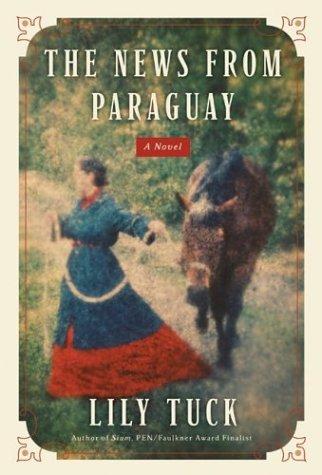
The News from Paraguay
Lily Tuck · b. 1938 · United States
Why it matters
Irish-born courtesan Eliza Lynch rises beside vain Paraguayan dictator Francisco Solano López as his ambition drives the country into one of the Americas' deadliest wars. Tuck's mosaic of short, accumulating vignettes won the National Book Award.
At a glance
Fragmented, present-tense vignettes skip across decades without conventional transitions.
Deep dive
How a Paris courtesan's decision to follow a besotted Latin American strongman home ends with her presiding, in Lily Tuck's telling, over one of the deadliest wars of the nineteenth century without ever quite admitting to herself what she has watched happen.
Written for readers who have finished the book. No plot recap, and nothing here is safe to read first.
Themes & symbolism
Tuck opens in Paris in 1854, where Ella Lynch, an Irish-born divorcee moving in the same circles as Napoleon's relatives, becomes the mistress of Francisco Solano Lopez, heir to Paraguay's presidency, courted with a poncho, a hired Paraguayan band, and a horse named after her. Ella follows him home to Asuncion and spends the rest of the novel reigning as his uncrowned consort, and Tuck's flat, almost diaristic prose, moving between third-person narration and Ella's own letters, keeps deliberate distance from Ella's interior life even as the reader watches her absorb, and eventually defend, Franco's escalating grandiosity.
That grandiosity drives Paraguay into the War of the Triple Alliance against Argentina, Brazil, and Uruguay, a conflict so catastrophically one-sided it kills a majority of Paraguay's adult male population, and Tuck stages Ella's gradual complicity as a portrait of imperial ambition working by proximity: she never declares war, never issues an order, but her presence at Franco's side, her refusal to see the war as anything but temporary, and her own appetite for the trappings of a throne that was never legally hers all help sustain a fantasy that costs an entire country its future.
History Interspersed, Never Explained
Tuck won the National Book Award while publicly admitting she had never set foot in Paraguay, and the novel's method matches that outsider's remove: dates and casualty counts arrive in clipped, unsentimental fragments alongside Ella's private correspondence, with almost no authorial commentary bridging the two registers. The effect keeps the historical devastation from ever becoming background scenery to a romance; it sits, unresolved and unexplained, directly against Ella's own account of her life, forcing the reader to do the work of connecting the war's scale to the woman who lived comfortably beside it.
Multiple Narrators, One Willful Blindness
Tuck occasionally breaks from Ella's point of view to let Franco's soldiers, servants, and even his horses narrate brief passages of their own, a formal choice that keeps the novel from collapsing into a single perspective's excuses. Those interruptions supply exactly the outside vantage Ella's own account withholds, ordinary Paraguayans registering the war's cost in ways she never does, so the reader's judgment of Ella forms in the gaps her narration leaves rather than in anything she admits to herself.
The last seal: what actually happens, and why it lands the way it does.
The ending, explained
By the war's final collapse, Franco has driven what remains of his army and government into retreat, and Tuck follows Ella through the ruin of everything the relationship promised her: she loses one of her sons and her partner within the same catastrophic stretch, forced to bury them essentially at once, in a landscape stripped of the resources for any proper reckoning with loss. Tuck refuses her heroine even the dignity of visible collapse, Ella doesn't weep or unravel on the page, she simply persists, moving from the near-royal status she had occupied in Asuncion back to relative poverty in Paris, the same city where her rise began. The novel's last note isn't tragedy so much as depletion, a woman who converted a nation's catastrophe into her own long, unremarkable decline, with no reckoning ever demanded of her.
Where to go next
 Jayne Anne Phillips · 2023Night WatchLvl 6Slow burn
 Charles Frazier · 1997Cold MountainLvl 4Medium pace
 Anthony Doerr · 2014All the Light We Cannot SeeLvl 4Fast paced
 Michael Ondaatje · 1992The English PatientLvl 7Slow burn
 Thomas Keneally · 1982Schindler's ArkLvl 4Fast paced
 Geraldine Brooks · 2005MarchLvl 5Medium pace