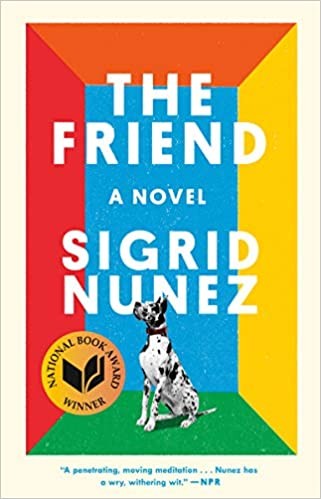
The Friend
Sigrid Nunez · b. 1951 · United States
Why it matters
An unnamed writer inherits her mentor's enormous, grieving Great Dane after his suicide, the dog's presence in her small apartment prompting a fragmented meditation on loss and literature. Nunez's National Book Award winner is essayistic grief at its most exact.
At a glance
Fragmented, essayistic structure asks readers to follow associative digression rather than plot.
Deep dive
Why a novel about a suicide spends most of its pages talking about a dog, and what that displacement is actually doing.
Written for readers who have finished the book. No plot recap, and nothing here is safe to read first.
Themes & symbolism
The narrator's grief for her mentor — a serially unfaithful, charismatic writer who leaves no note — never gets addressed head-on for long; it keeps sliding sideways into essayistic digression on writing workshops, other writers' suicides, canine cognition, Rilke, the ethics of memoir. Nunez's real subject is the impossibility of grieving in a straight line, and the novel's fragmented, quotation-heavy form, closer to commonplace book than conventional fiction, enacts that impossibility rather than describing it.
Apollo, the mentor's enormous Great Dane, becomes the site where mourning finally locates a body to attach itself to: too big for the narrator's rent-controlled, dog-restricted apartment, uninterested in her at first, he forces a relationship built on inconvenience and patience rather than sentiment, which is precisely why it works where direct grief hasn't. The dog can't be asked to explain the suicide or absolve anyone of complicity in it — several of the mentor's wives and lovers appear, implicitly indicted — so caring for him becomes a way of honoring the dead man without having to interrogate him.
Nunez keeps circling back to the mentor's serial infidelities and the wreckage they left among his wives and students, never quite letting the narrator's own devotion to him curdle into simple critique or simple forgiveness; the novel's restraint on this point is itself an argument, that grief and clear-eyed judgment of the dead can coexist without canceling each other out. Apollo's grief, meanwhile, mirrors and interrupts the narrator's own — a dog visibly mourning a specific, absent person offers her a form of company no human confidant, all preoccupied with their own theories about the suicide, quite manages to provide.
Second-Person Address and the Absent Mentor
Nunez writes much of the book as a direct, unanswerable address to the dead mentor — 'you' did this, 'you' said that — a device that keeps him simultaneously present and unreachable throughout, an ongoing one-sided conversation that mimics exactly the shape grief takes when the person who could resolve your questions about them is no longer available to ask.
Writing About the Dead as an Ethical Problem
The novel worries openly about its own existence: is turning a friend's suicide, and his surviving wives' and students' reactions to it, into publishable material an act of care or exploitation? Nunez lets the narrator's uncertainty stand unresolved, making the book's own status as autofiction-adjacent grief-writing part of what it interrogates rather than a question it answers from outside itself. The narrator's own students supply a running counterpoint, arguing in workshop about whether fiction has any right to lift material wholesale from real, unconsenting lives — a debate the novel is visibly having with itself in real time, never quite landing on a verdict it's willing to defend.