
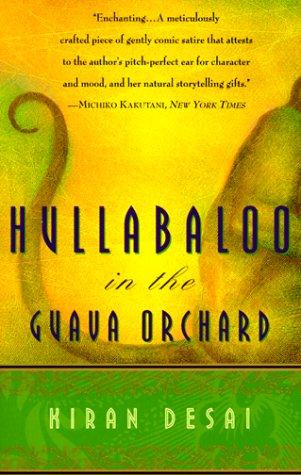
Hullabaloo in the Guava Orchard
Kiran Desai · b. 1971 · India / United States
Why it matters
A hapless postal clerk climbs a guava tree to escape his small town and is mistaken for a holy man by adoring crowds below, then upstaged by a troop of liquor-guzzling monkeys. Desai's antic, cheerfully absurd debut, written well before her prizewinning turn toward grief.
At a glance
Fast-paced comic set pieces in accessible prose, with a light satirical edge.
Deep dive
A postal clerk climbs into a guava tree to escape his job and his family, and an entire town decides that makes him a holy man, with consequences that spiral well past anything Sampath actually wanted.
Written for readers who have finished the book. No plot recap, and nothing here is safe to read first.
Themes & symbolism
Sampath Chawla's flight into the orchard tree reads, for the first stretch of the novel, as simple failure dressed up as eccentricity, a clerk who can't hold a job or meet his family's modest expectations finding the one form of retreat nobody can order him down from, and Desai gets sustained comedy from how fast Shahkot converts that retreat into sanctity, his most ordinary mutterings reinterpreted as wisdom the moment enough people decide to listen for it.
His mother Kulfi, whose lifelong obsession with elaborate cooking has always outpaced the family's means, finds in Sampath's sudden fame a vocation of her own, feeding the pilgrims who gather beneath the tree increasingly baroque dishes, and Desai lets Kulfi's appetite and Sampath's withdrawal read as matched responses to the same starved, provincial life, one parent expanding outward as the son shrinks into a single branch. Sampath's younger sister Pinky, meanwhile, wants nothing more exotic than an ordinary romance and an ice cream van driver she's fixed on marrying, and her thwarted, thoroughly unspiritual ambitions sit next to her brother's accidental sainthood as Desai's reminder that Shahkot's other residents have wants of their own that nobody is building a shrine around.
The langurs that move into the orchard and discover a devotee's stash of rum-soaked snacks escalate the satire from family comedy into civic farce: a troop of drunk, increasingly violent monkeys becomes a genuine administrative crisis, and the government's response, culminating in an armed operation against an orchard, says more about the state's priorities than anything it ever does for Shahkot's actual poor.
A Family Embarrassed by Its Own Holy Man
Sampath's father, furious and humiliated by his son's flight up a tree, and his mother Kulfi, quietly delighted by the fame it brings, pivot from crisis management to profit within a few chapters, his disgrace repackaged as a tourist attraction almost before anyone thinks to ask whether Sampath actually wants disciples at all.
Drunk Monkeys as Slapstick with a Point
The langurs smashing crockery, raiding kitchens, and terrifying the district administration give Desai her sharpest satire in the book: watching how quickly the state mobilizes an armed operation against inconvenience while leaving Shahkot's actual poverty untouched, a monkey problem gets more official urgency than a human one ever did.
The last seal: what actually happens, and why it lands the way it does.
The ending, explained
The government and military, dispatched to clear Shahkot of its now-notorious drunken monkeys, converge on the guava orchard for a final operation, guava-gas canisters included, expecting to remove Sampath along with the troop. Instead they find him gone. In the branches where he'd been sitting since the novel's opening pages, in retreat from the family and job he was failing at long before anyone called him a holy man, there is only a large guava, as if he had simply completed a process the orchard had been working on him the whole time. Desai refuses to adjudicate whether Sampath achieved transcendence, escaped into the forest with the monkeys, or simply vanished the way anything overlooked eventually does: Shahkot, thrilled by its own brief fame, packs up and returns to ordinary life either way.
Where to go next
 Kiran Desai · 2006The Inheritance of LossLvl 6Slow burn
 Anita Desai · 1980Clear Light of DayLvl 5Slow burn
 Salman Rushdie · 1981Midnight's ChildrenLvl 8Medium pace
 Aravind Adiga · 2008The White TigerLvl 4Fast paced
 Shehan Karunatilaka · 2022The Seven Moons of Maali AlmeidaLvl 6Fast paced
 Zadie Smith · 2000White TeethLvl 5Medium pace