
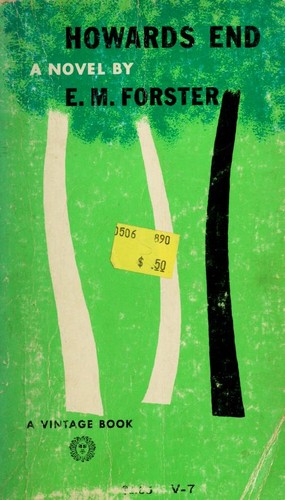
Howards End
E. M. Forster · 1879–1970 · England
Why it matters
'Only connect': three families, the cultured, the commercial, and the poor, collide over a house and England's soul. Forster's plea for empathy across class, and its costs.
At a glance
Measured, aphoristic narration balancing several class perspectives at once.
Deep dive
Why Forster keeps circling back to a single wych-elm tree with pig's teeth pressed into its bark, and what the house he names the book after is actually deciding about who England belongs to.
Written for readers who have finished the book. No plot recap, and nothing here is safe to read first.
Themes & symbolism
The Schlegel sisters, cultured, half-German, given to long conversations about art and personal relations, and the Wilcoxes, brisk, commercial, allergic to anything that cannot be converted into practical use, are Forster's deliberate types rather than individuals, and the novel's famous epigraph, only connect, names the project Margaret Schlegel takes on directly when she marries Henry Wilcox: an attempt to fuse his competence with her culture, prose with passion, rather than let England's two temperaments keep operating in separate, mutually contemptuous spheres.
Leonard Bast, a poor insurance clerk the Schlegels take a well-meaning interest in, is where Forster's reconciliation project runs out of road: neither the Wilcoxes' commercial energy nor the Schlegels' cultured sympathy can actually rescue Leonard from the economic floor he is standing on, and his slow ruin, sacked from his job partly on Henry Wilcox's own careless advice, shows exactly how much collateral damage the novel's genteel drama of connection is willing to absorb from someone with no capital, cultural or financial, to protect him.
Henry's own motto for getting through a crisis, telegrams and anger, meeting trouble with speed and decisiveness rather than reflection, sums up everything the Wilcoxes bring to the marriage that the Schlegels lack and everything the Schlegels fear it will cost them, and Forster lets Margaret adopt fragments of that same brisk competence herself as the novel goes on, without ever fully trading away the inward attentiveness that made her worth marrying in the first place.
The Tree With Teeth in It
The ancient wych-elm on the grounds of Howards End, studded with pigs' teeth by farm children generations earlier as a folk cure for toothache, gives Forster his clearest image of England's older, half-forgotten continuity, a magic neither the Schlegels' Continental culture nor the Wilcoxes' modern efficiency has any real vocabulary for. Mrs. Wilcox's near-mystical bond with the tree and the house itself, passed to Margaret in spirit long before it is passed to her legally, frames the entire novel's real argument: that England's actual inheritance runs through instinct and rootedness rather than through either of the more articulate, more visible value systems the two families represent.
The last seal: what actually happens, and why it lands the way it does.
The ending, explained
Ruth Wilcox's dying wish to leave Howards End to Margaret, scrawled on an unwitnessed note the family destroys as an eccentric impulse not worth honoring, is fulfilled anyway years later, after Henry marries Margaret, after Helen's unplanned pregnancy by Leonard scandalizes the family, and after Leonard's death, triggered by a physical confrontation with Henry's son Charles, who is sent to prison for it, finally exposes the cost the Wilcoxes' brisk competence has been quietly imposing all along. Henry, broken by his own son's disgrace in a way none of Margaret's arguments could ever manage, gives her Howards End outright, and the novel closes with Margaret, Helen, and Helen's baby settled at the house together, Ruth Wilcox's original, unwitnessed wish honored at last, though only after the reconciliation has cost a man who never had a stake in either family's argument his life.
Where to go next
 E. M. Forster · 1924A Passage to IndiaLvl 6Medium pace
 Paul Scott · 1977Staying OnLvl 4Slow burn
 Zadie Smith · 2000White TeethLvl 5Medium pace
 Evelyn Waugh · 1945Brideshead RevisitedLvl 5Medium pace
 Muriel Spark · 1961The Prime of Miss Jean BrodieLvl 4Fast paced
 Iris Murdoch · 1978The Sea, the SeaLvl 6Slow burn