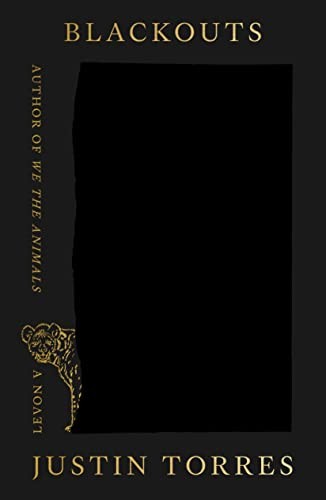
Blackouts
Justin Torres · b. 1980 · United States
Why it matters
A young gay narrator sits at a dying man's bedside to recover and revise a real, long-suppressed 1941 study of queer lives, its pages interleaved with redacted archival photographs. Torres's National Book Award winner reconstructs a history erasure tried to bury.
At a glance
Archival fragments, redacted text, and a nonlinear frame narrative resist a straightforward reading.
Deep dive
Why a young narrator's deathbed visits with a dying older man named Juan Gay turn into an argument, conducted through a real 1941 medical textbook the two of them are annotating together, about who gets to own a queer life once institutions have already written it down.
Written for readers who have finished the book. No plot recap, and nothing here is safe to read first.
Themes & symbolism
Torres builds the novel around visits the unnamed narrator pays to Juan Gay, dying in a strange desert institution called the Palace, and structures their exchanges as a kind of call and response: Juan tells stories, the narrator writes them down, and both of them work through an actual historical book, Sex Variants: A Study of Homosexual Patterns, a 1941 case study collection compiled by doctors who interviewed queer subjects in order to pathologize them. Central to that book, and to Torres's novel, is a real researcher named Jan Gay, whose original interviews and data the credited doctors absorbed into their own authorship, erasing her from the very study she made possible, a historical theft Juan's invented name is built to keep alive.
Torres reproduces pages from Sex Variants throughout the novel, blacked out with redaction bars that leave only scattered words behind, an erasure-poetry technique that turns the clinical language used to diagnose and contain queer lives back into something closer to lyric. The blackout isn't destruction, it's a rescue performed through vandalism: cutting away the institutional framing that made variant testimony legible only as pathology and leaving behind fragments that read, once freed of the case-study format, like the actual voices the doctors thought they were merely recording.
Jan Gay, the Woman the Doctors Erased
The real Jan Gay spent years interviewing queer subjects across the country for what she intended as her own book before handing the material over to the physicians who published Sex Variants under their own names, a footnote-level acknowledgment the only trace left of her actual authorship. Torres renders that erasure literally in the novel's title: blackouts describes both the redacted pages and the entire mechanism by which an institution can absorb someone's labor and identity and publish the result as objective science.
Storytelling as the Inheritance
The narrator's relationship to Juan runs on an unstated but total trust that the stories being exchanged, some clearly true, some just as clearly invented or borrowed, matter more for what they preserve between two people than for their factual accuracy. Torres keeps the narrator's own history, why he's there, what he owes Juan, deliberately underlit, so that the novel's real subject becomes less a specific plot than an act of transmission: an archive built by hand, between two people, against a documentary record that was never built to hold either of them accurately.
The last seal: what actually happens, and why it lands the way it does.
The ending, explained
Juan dies before the narrator finishes fully absorbing everything Juan meant to pass down, and Torres declines to stage the death as a scene, it happens mostly in the white space between the novel's fragments, consistent with a book that has spent its length arguing against tidy documentary closure. What the narrator is left holding is the composite archive the two of them built together, Juan's stories, the blacked-out pages of Sex Variants, the recovered outline of Jan Gay's erased authorship, all of it assembled into something neither a memoir nor a case study but a third form built specifically to resist becoming either. The novel's last movement treats that unfinished, hand-assembled inheritance as the only honest way to end a book about a life the official record was never equipped to hold, complete not because the story is finished but because the narrator has accepted the job of carrying it forward.