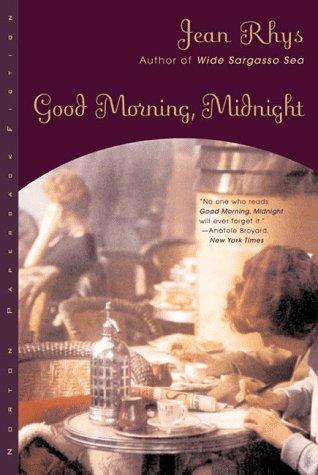
Good Morning, Midnight
Jean Rhys · 1890–1979 · United Kingdom / Dominica
Why it matters
An aging, impoverished Englishwoman drifts through 1930s Paris hotels and cafés, drinking to hold off despair. Rhys's interwar novels of female precarity anticipated Wide Sargasso Sea's themes by decades, largely unread until her late rediscovery.
At a glance
Fragmented stream-of-consciousness drifting between present despair and unreliable memory.
Deep dive
Sasha Jansen drifts through Paris hotel rooms and secondhand memories, and Rhys builds a portrait of a woman armoring herself against pity that keeps failing to hold.
Written for readers who have finished the book. No plot recap, and nothing here is safe to read first.
Themes & symbolism
Sasha Jansen narrates her days in late-1930s Paris, cheap hotels, secondhand dresses, wine bought to blur the afternoon, in a voice that slides without warning between the present errand and a memory she'd rather not be having, most often the brief marriage to Enno and the death of the baby she had with him, which the novel approaches sideways for most of its length rather than head-on. Rhys builds Sasha's fragmentation into the sentence itself, tense and time slipping mid-paragraph, so the reader inherits the same difficulty Sasha has telling which decade she's currently surviving. The title itself is lifted from an Emily Dickinson poem, Good Morning, Midnight, I'm coming home, which Rhys sets as epigraph, casting the entire narration as an address to the dark rather than to any listener who could actually help her.
René, a young gigolo who attaches himself to Sasha with a flattery she recognizes as calculated and craves anyway, becomes the novel's test of whether she can still risk wanting anything: her wariness toward him, expecting the con before it arrives, reads as hard-earned intelligence and self-destruction at once, since the same defenses that protect her from being used again also foreclose any chance of the thing she is actually starving for. A silent, dressing-gowned man in the room next door, a commercial traveler she keeps half-noticing and dreading, threads through the book as a low, constant unease, arriving at real significance only in the novel's final pages.
The Book That Nearly Erased Its Author
Published in early 1939, months before Europe went to war again, Good Morning, Midnight found almost no readership and Rhys herself largely vanished from literary life afterward, so thoroughly that a 1949 BBC radio adaptation had to run a public appeal simply to locate her, with some in London's literary world assuming she had died. That near-disappearance lasted until the 1950s and 60s, when Rhys resurfaced to write Wide Sargasso Sea, and Sasha's own hard-won art of making herself small and unnoticed to survive a world that has stopped seeing her reads, in hindsight, uncomfortably close to what happened to the woman who wrote her.
The last seal: what actually happens, and why it lands the way it does.
The ending, explained
After René leaves for good, disgusted by Sasha's refusal to let herself trust him even in the moment she most wants to, she drinks alone in her room until the dressing-gowned man from next door, who has unsettled her with silent visits throughout the book, finally lets himself in. Rather than resist him, Sasha pulls him toward her, repeating yes, yes, yes in the novel's last lines, an ending Rhys refuses to resolve into either surrender or grim self-assertion: it echoes, almost word for word, an earlier moment of real tenderness with Enno, so the same phrase that once meant love now closes the book meaning something closer to the exhausted opposite of it.