
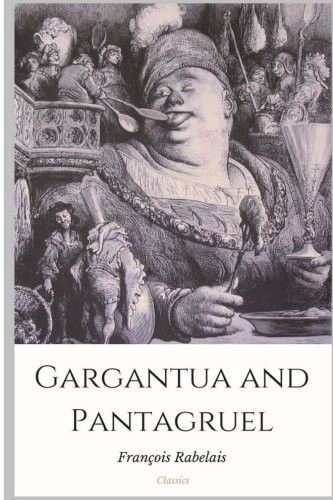
Gargantua and Pantagruel
François Rabelais · 1494–1553 · France
Originally Gargantua et Pantagruel (French)
Why it matters
Two generations of giants eat, drink, urinate, wage war, and debate philosophy across five anarchic volumes. Renaissance humanism smuggled inside the dirtiest comedy of its century: 'Rabelaisian' still names excess deployed as freedom.
At a glance
Torrential wordplay, mock-scholarly lists, and dense topical satire; dip in rather than march through.
Deep dive
Why 'Do What Thou Wilt' is a joke with a very narrow guest list, and why nobody's entirely sure who wrote the book's supposed last word.
Written for readers who have finished the book. No plot recap, and nothing here is safe to read first.
Themes & symbolism
Rabelais's giants are grotesque-realist bodies in Bakhtin's sense: eating, drinking, and urinating at a scale that makes bodily function impossible to ignore or dignify past. Gargantua's newborn urine floods Paris; Pantagruel's birth coincides with a drought so severe it reads as cosmic overcompensation. The comedy is a leveling device — kings, scholars, and popes get reduced to digestive systems on the same page as high theology and classical allusion, and the sheer scale of the bodily grotesque is doing satirical work against ecclesiastical and scholastic self-importance that argument alone couldn't manage.
Education is the book's other real battlefield. Gargantua's early tutors drill him in rote scholastic Latin and produce, by design, a dim and joyless boy; Ponocrates's humanist regimen — physical exercise, observation of the natural world, reading in the vernacular — remakes him within a year, and the contrast is Rabelais staging the era's humanist-versus-scholastic argument as literal plot rather than treatise. Language itself keeps getting put on trial too: a Limousin scholar who mangles his French with pretentious Latinate coinages gets mocked and threatened until he reverts to plain speech, Rabelais's running joke that empty rhetoric is its own kind of violence.
The Abbey of Thélème: Utopia Without a Rule Book
Built as a reward for the brawling, unpious Friar John, Thélème inverts every convention of the monastery — no poverty, chastity, or obedience, residents free to marry and leave at will, its single law inscribed over the gate: Fay çe que vouldras, do what thou wilt. It reads as sincere anti-monastic utopia and self-undermining joke at once: freedom here works only because the abbey admits nobody but the young, beautiful, and well-bred, on the theory that honor is bred into aristocrats and will restrain them without external rule. Rabelais's most famous liberatory gesture turns out to have a strict guest list — a limit later readers, including Aleister Crowley when he borrowed the motto centuries afterward, tend to leave out.
The Oracle of the Bottle, and Whose Ending It Is
Book Five sends Panurge and company on a mock-Odyssean voyage to consult the Oracle of the Holy Bottle on whether he should marry, and the quest resolves in a single word, Trinch — drink — treated for centuries as Rabelais's philosophical last word, wisdom dissolved into wine rather than doctrine. But Book Five was published posthumously in 1564, roughly a decade after Rabelais is presumed to have died, and its authorship has been disputed ever since; it may be substantially finished or padded out by other hands from his notes. The pentalogy's most quoted "ending," in other words, might not be an ending Rabelais actually wrote — a fittingly anarchic problem for a book this suspicious of tidy authority in the first place.
Even taken at face value, Trinch resolves nothing Panurge actually asked about — whether he should marry stays as unsettled after the oracle as before it, since every earlier authority he consulted (a witch, a poet, a theologian, a philosopher, a fool) gave him contradictory advice too. Reading the whole quest as a joke about the impossibility of a definitive last word fits a five-book work this openly unconcerned with tidy closure far better than reading it as settled wisdom — whoever actually wrote the final page.
Where to go next
 Michel de Montaigne · 1580The EssaysLvl 6Slow burn
 Edmund Spenser · 1590The Faerie QueeneLvl 9Slow burn
 John Milton · 1667Paradise LostLvl 8Slow burn
 Geoffrey Chaucer · 1400The Canterbury TalesLvl 7Medium pace
 Laurence Sterne · 1759The Life and Opinions of Tristram Shandy, GentlemanLvl 9Slow burn
 William Shakespeare · 1601HamletLvl 6Medium pace