
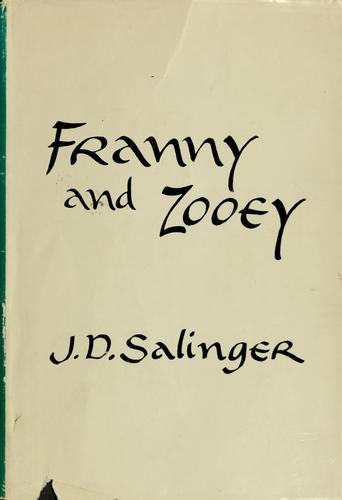
Franny and Zooey
J. D. Salinger · 1919–2010 · United States
Why it matters
A college girl's spiritual crisis over a pilgrim's prayer book is met, over one long day, by her brother's exasperated, tender counterargument. Two linked stories tracing the Glass family's peculiar brilliance and breakdown.
At a glance
Talky, digressive dialogue carries most of the weight, in otherwise plain prose.
Deep dive
Why Salinger pairs one sister's collapse on a college weekend with her brother's long, furious argument from the bathtub, and what the Fat Lady turns out to have to do with either of them.
Written for readers who have finished the book. No plot recap, and nothing here is safe to read first.
Themes & symbolism
'Franny' stays close and third person as Franny Glass, visiting her boyfriend Lane Coutell for a football weekend, tries to explain her sudden obsession with 'The Way of a Pilgrim' and its instruction to repeat the Jesus Prayer without ceasing, and finds Lane constitutionally unable to hear anything past his own satisfaction at having a pretty, brilliant girlfriend across the table. Her breakdown at the restaurant, half spiritual crisis and half plain exhaustion with the performing intellectual world both of them were raised inside, ends the shorter piece unresolved on purpose.
'Zooey' relocates entirely to the Glass family apartment and answers Franny's crisis from inside the family that produced it. Buddy Glass narrates, insisting in a long preamble that what follows is not really fiction, before handing the story to his brother Zooey, who tries reasoning with Franny in the bathroom, then again by reading her their dead brother Seymour's old letters, and finally by phone, using every tool the Glass children's strange, precocious religious education gave them.
One Family Crisis, Two Different Narrators
Salinger deliberately mismatches his two pieces: 'Franny' is a compact third-person story with no framing device, while 'Zooey' is a much longer novella narrated by Buddy, who claims at length that he is offering a 'prose home movie' rather than a proper story. The shift in scale and voice mirrors the shift in method Zooey himself is attempting, moving Franny from private crisis into the noisy, argumentative intimacy only her family can supply.
Seymour's Letters as the Family's Real Scripture
Seymour never appears alive in either piece; he is already years dead by the time Franny's crisis begins, a fact the book assumes the reader already carries in from the earlier stories about the Glass children. What survives him is paper, an old letter to Buddy that Zooey rereads in the bathtub before his phone call, and the memory of the radio quiz show that put all seven Glass children on air as children, which Zooey blames, half seriously, for teaching every one of them to distrust whatever audience they have left.
The last seal: what actually happens, and why it lands the way it does.
The ending, explained
Zooey's real breakthrough comes only after subterfuge: he calls Franny on their late brother Seymour and Buddy's old private telephone line, briefly pretends to be Buddy, and Franny, recognizing his voice at once, is furious at the trick before he ever reaches his actual point. That point is Seymour's old instruction to always shine your shoes for the invisible Fat Lady in the audience of their childhood radio show, someone Zooey now identifies flatly as Christ, so that every unglamorous act of attention, even shining shoes no one will see, becomes a form of prayer. Franny goes quiet on the line, then smiles, then simply holds the receiver in silence for a long moment before finally, peacefully, falling asleep, the spiritual crisis that opened 'Franny' answered not with an argument but with permission to stop performing seriousness and live inside it instead.
Where to go next
 J. D. Salinger · 1951The Catcher in the RyeLvl 3Fast paced
 Sherwood Anderson · 1919Winesburg, OhioLvl 3Medium pace
 Mark Twain · 1884Adventures of Huckleberry FinnLvl 5Fast paced
 Kurt Vonnegut · 1969Slaughterhouse-FiveLvl 5Fast paced
 Carson McCullers · 1940The Heart Is a Lonely HunterLvl 5Medium pace
 Mavis Gallant · 2002Paris StoriesLvl 5Medium pace