
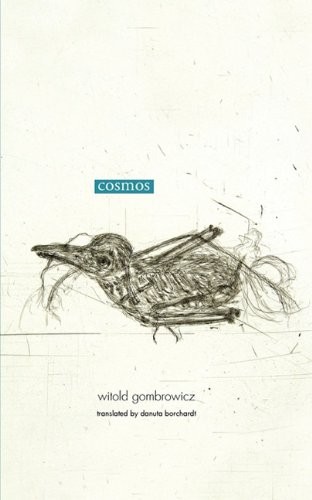
Cosmos
Witold Gombrowicz · 1904–1969 · Poland
Originally Kosmos (Polish)
Why it matters
Two young men on holiday become obsessed with a series of trivial, possibly meaningless signs: a hanged sparrow, a mark on a ceiling. Gombrowicz's late masterpiece turns paranoid pattern-seeking into a metaphysical detective story.
At a glance
A deliberately paranoid, digressive narrator obsesses over meaningless detail with no plot resolution.
Deep dive
Two young men on a mountain holiday start finding portents in a hanged sparrow, a mark on a ceiling, and a maid's disfigured mouth, and Gombrowicz never quite lets you decide whether they're detectives or the ones inventing the mystery.
Written for readers who have finished the book. No plot recap, and nothing here is safe to read first.
Themes & symbolism
Witold and Fuchs arrive at a boarding house in the mountains and, almost immediately, find a sparrow hanging from a length of wire in the garden, a small found object that should mean nothing and instead becomes the seed of an investigation neither man can stop pursuing. Gombrowicz builds the whole novel out of this compulsion: a mark on the bedroom ceiling shaped like an arrow, a stick balanced against a wall, and the maid Katasia's scarred, asymmetrical mouth all get folded into a private system of signs that Witold assembles out of pure appetite for connection, the mind's refusal to accept that some things simply happen without meaning anything.
Katasia's disfigured lip and Lena, the household's ordinary daughter, split the novel's real obsession into two versions of the same fixation: Witold's attention keeps sliding from one mouth to the other, unable to settle on which woman actually holds whatever he thinks he's chasing, because the chase was never really about either of them. Leon, Lena's father, runs his own private games and invented rituals with his wife at the dinner table, a domestic strangeness that shows the household was already primed to generate the kind of arbitrary pattern Witold and Fuchs keep discovering outside it.
An International Prize, Decades After Ferdydurke
Gombrowicz wrote Cosmos in the south of France in the mid-1960s, after twenty-four years of exile in Argentina had ended and a late, hard-won European reputation had finally caught up with him. In 1967 the novel shared the International Prize for Literature with Samuel Beckett, a joint honor that confirmed, near the end of Gombrowicz's life, the same paranoid, form-obsessed method critics had dismissed as eccentric when Ferdydurke first appeared three decades earlier. The pairing with Beckett was apt: both writers had spent careers arguing that the patterns a mind imposes on experience say more about the mind than about the world it's supposedly describing, and Cosmos applies that argument to detective fiction's own machinery of clues and deduction rather than to language or theater, as Beckett had.
The last seal: what actually happens, and why it lands the way it does.
The ending, explained
Witold's fixation finally drives him to act rather than merely observe: alone with Lena's cat, he strangles it and leaves it hanging from a branch, an act that recreates the sparrow from the novel's opening pages rather than explains it, proof that the meaning he had been chasing all along was one he was fully capable of manufacturing with his own hands. Leon finds the cat and, rather than treating it as evidence of anything sinister, simply folds it into the household's ongoing appetite for symbol and coincidence, never identifying Witold as the culprit. The novel closes at a large family lunch, Lena's engagement to Ludwik proceeding as planned, and Leon wringing a chicken's neck for the table with the same offhand vigor as every other death in the book, absorbing Witold's private compulsion back into the ordinary, appetite-driven violence of daily life, where it apparently belonged all along.
Where to go next
 Witold Gombrowicz · 1937FerdydurkeLvl 7Fast paced
 Franz Kafka · 1915The MetamorphosisLvl 4Medium pace
 Bohumil Hrabal · 1976Too Loud a SolitudeLvl 6Slow burn
 Bruno Schulz · 1934The Street of CrocodilesLvl 8Slow burn
 Milan Kundera · 1984The Unbearable Lightness of BeingLvl 5Slow burn
 László Krasznahorkai · 1985SatantangoLvl 9Slow burn