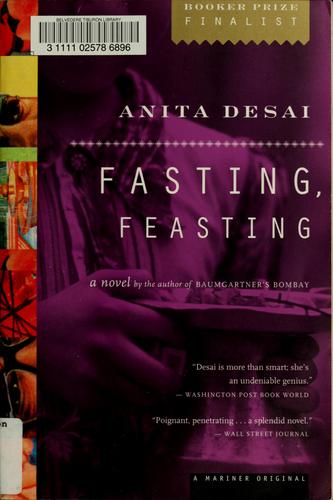
Fasting, Feasting
Anita Desai · b. 1937 · India
Why it matters
An unmarried Indian daughter's constrained life is set against her brother's alienated one studying in suburban America. Desai's Booker-shortlisted diptych on the different hungers (literal and otherwise) that discipline men and women.
At a glance
Two clearly split, plainly narrated halves; difficulty is thematic rather than syntactic.
Deep dive
Anita Desai tells the same family's story twice, once for the daughter kept home in India and once for the son sent abroad to study, and lets the reader notice long before either sibling does that neither household is as different as it looks.
Written for readers who have finished the book. No plot recap, and nothing here is safe to read first.
Themes & symbolism
Uma, the family's overworked eldest daughter, spends the novel's first half absorbing every failure the household produces, pulled from school to nurse a newborn sibling, married off twice with disastrous results, kept home as unpaid labor while her younger sister Aruna is married well and her brother Arun is sent to study in America, and Desai builds Uma's confinement less through any single dramatic cruelty than through the sheer accumulation of small, unremarkable refusals.
Arun's half of the novel, set among an American host family in Massachusetts, trades Uma's overt patriarchal control for something Desai suggests is nearly as constricting: a father obsessed with grilling meat, a daughter with her own eating disorder, and a mother, Mrs. Patton, quietly starving herself amid the family's visible abundance, so fasting and feasting read as two names for the same withheld appetite rather than opposites. Desai never puts Uma and this recognition in the same room: the novel's two halves rhyme silently across an ocean rather than meet, and nobody inside either household is positioned to see the whole pattern Desai has spent the book laying out for the reader alone.
Uma's Foiled Marriages as the Household's Real Plot
Two attempts to marry Uma off structure the novel's first half: one dissolves once the family discovers the deception behind it, another ends within weeks when it emerges the groom already has a wife, and each failure sends Uma home with slightly less standing than before, marriage functioning less as a path to autonomy than as one more mechanism for keeping an unwanted daughter contained.
Arun's America as a Mirror, Not an Escape
The Massachusetts household that hosts Arun for the summer gives Desai a second, formally separate case study in the same disease as Uma's: a family that looks like freedom from the outside and functions, on the inside, by exactly the same rules of denial and control that shaped the daughter left behind in India.
The last seal: what actually happens, and why it lands the way it does.
The ending, explained
The novel's two halves never really touch: Uma's story in India and Arun's in Massachusetts share no plot events, only the family that produced both of them and failed each differently. Desai closes on Arun rather than Uma, watching him hand Mrs. Patton, deep in her own eating disorder and largely unseen by her husband, a package his mother sent, a shawl and a tin of tea Uma was made to pack before he left. It's a small, almost throwaway gesture, but it closes the book's real argument: that the deprivation Uma suffers under an openly patriarchal household and the deprivation Mrs. Patton suffers inside an outwardly indulgent, food-obsessed American one are the same hunger wearing different manners, and Arun, who has spent the whole American section refusing to eat what's put in front of him, is the only character alert enough to notice.