
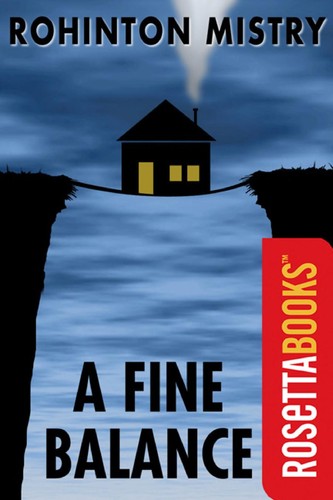
A Fine Balance
Rohinton Mistry · b. 1952 · India / Canada
Why it matters
Four strangers (a widow, a student, and two tailors fleeing caste violence) are thrown together in one Bombay apartment during Indira Gandhi's Emergency. Friendship as the last defense against a merciless, arbitrary state.
At a glance
Accessible realist prose, though its unrelenting accumulation of tragedy is emotionally demanding.
Deep dive
Four strangers share one cramped Bombay flat during the Emergency, and how far the novel is willing to let that fragile arrangement be tested before deciding whether kindness can survive a state built on quotas.
Written for readers who have finished the book. No plot recap, and nothing here is safe to read first.
Themes & symbolism
Dina Dalal takes in two tailors and a student boarder to keep her rented flat and her independence from a controlling brother, and Mistry builds the novel's whole architecture around that unlikely household: a Parsi widow, a Hindu student from the hills, and two Chamaar men, Ishvar and Omprakash Darji, whose family broke from generations of cobbling to apprentice as tailors precisely to escape the caste violence a leather-worker's life invited. The escape doesn't hold. The novel tracks how thoroughly caste violence follows a family even after it changes trade, culminating in a landlord's revenge against Om's father for refusing to cast his vote as ordered.
Indira Gandhi's 1975-77 Emergency supplies the novel's other engine: slum demolitions, forced sterilization quotas, and a beggar economy run by a ruthless Beggarmaster who mutilates children to make them more profitable, all rendered with the same unblinking specificity Mistry gives the caste plot. The title's balance is never a comfort. It's Dina's own maxim, that life requires a fine balance between hope and despair, tested past any point where philosophy is much use, and the novel's real cruelty is how evenly it distributes suffering across characters who did nothing to deserve concentrating that much of it.
An Independent Vote and Its Price
The caste violence shaping Ishvar and Om's lives predates the city entirely: Om's father, taught to read by the tailor who trained him and his brother out of the family's hereditary cobbling trade, insists on casting his own vote in a village election rather than the block vote the landlord expects from the Chamaar quarter. The landlord's revenge, a massacre of the household while Ishvar and Om are away apprenticing, is the novel's founding atrocity, and Mistry makes sure the city plot never lets the reader forget that the same man resurfaces decades later as a local functionary running Emergency-era sterilization quotas, close enough to recognize Om and finish what the village started.
Balance as Threat, Not Comfort
Dina's own governing philosophy, that life requires a fine balance between hope and despair, gives the novel its title and its irony: every scale in the book tips toward despair, from the Emergency's slum clearances to the Beggarmaster's economy of engineered mutilation. Mistry uses the phrase less as wisdom to live by than as a claim the plot spends six hundred pages disproving.
The last seal: what actually happens, and why it lands the way it does.
The ending, explained
Om is castrated rather than merely sterilized when a local official recognizes him as the tailor's son and settles an old score under cover of the government's vasectomy camps, and Ishvar later loses both legs to gangrene from an untreated wound picked up in the same forced roundup. The two men end up begging on Bombay's streets, transformed from independent tailors into figures whose survival depends on a stranger's coin, while Dina, evicted from her flat by her landlord, moves back under her overbearing brother's roof, the independence she fought the whole novel to keep finally gone. Maneck, who has left India for a job abroad, returns years later to find Dina diminished and Ishvar and Om unrecognizable, and reacts not with the reunion the earlier chapters primed a reader to expect but with a despair the novel has been building toward all along. The four survivors' fates refuse any of them a clean rescue, insisting the fine balance was never within their control to keep.
Where to go next
 Rohinton Mistry · 1991Such a Long JourneyLvl 5Medium pace
 Arundhati Roy · 1997The God of Small ThingsLvl 7Slow burn
 Aravind Adiga · 2008The White TigerLvl 4Fast paced
 Anita Desai · 1980Clear Light of DayLvl 5Slow burn
 Mahasweta Devi · 1974Mother of 1084Lvl 5Medium pace
 Bernardine Evaristo · 2019Girl, Woman, OtherLvl 4Fast paced