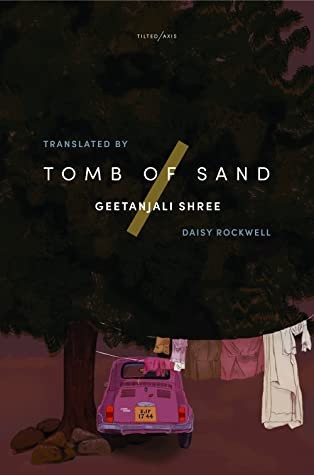
Tomb of Sand
Geetanjali Shree · b. 1957 · India
Originally Ret Samadhi (Hindi) · translated by Daisy Rockwell
Why it matters
An octogenarian widow, freed by her husband's death, crosses the border into Pakistan to confront the Partition trauma she has carried her whole life, in prose that turns grief restless and playful rather than solemn. The first Hindi-language novel to win the International Booker Prize.
At a glance
Long, digressive, wordplay-heavy sentences and a loose structure demand patience over plot.
Deep dive
Why a novel about grief, Partition, and an eighty-year-old widow's border crossing insists on being funny, punning, and structurally unruly instead of solemn.
Written for readers who have finished the book. No plot recap, and nothing here is safe to read first.
Themes & symbolism
Ma spends the opening chapters turned literally away from the world — facing the wall, refusing to get up — and the novel's central image is her eventual reversal: crossing back through a door, then a national border, into a life she had spent decades with her back to. Shree treats doors, walls, and the India–Pakistan border itself as versions of the same permeable membrane, things that look absolute until someone simply turns around and walks through them, which is exactly the quietly radical act Ma performs by choosing motion over confinement in old age.
A recurring crow, sharp-tongued and boundary-crossing, along with a companion figure whose gender resists easy classification, keep dissolving categories the novel insists are more porous than convention admits — between genders, between the living and the dead, between one side of the border and the other. Partition itself becomes not a historical event safely sealed in 1947 but an unhealed line still running through Ma's body and biography, proof that the wound of division doesn't stay in the past tense just because the treaties did.
Ma's old age and physical frailty, far from being treated as decline, become the precondition for her freedom: dependent on a cane, moving slowly, dismissed by her own family as past the age where anyone expects anything of her, she uses exactly that low expectation as cover to do the one thing no one anticipated — leave. Shree makes disability and advanced age a loophole in patriarchal supervision rather than a limit on it, which is its own quiet rebuttal to how both are usually written.
A Novel That Refuses to Behave
Shree's prose is deliberately digressive, pun-drunk, and allergic to a tidy plot arc — sentences double back, wordplay multiplies meanings rather than settling them, and the crow's cawing becomes its own recurring linguistic joke. That formal unruliness is the book's argument in miniature: grief over Partition and over a life spent shut indoors doesn't have to be told in a solemn register to be taken seriously, and playfulness turns out to be a legitimate, even necessary, tool for approaching trauma too large for straight-faced narration.
The First Hindi Novel to Win the International Booker
Daisy Rockwell's 2021 translation, working from Shree's original Ret Samadhi, brought the novel to English-language readers only shortly before its Booker win, exposing how thoroughly the prize's usual radar had missed Hindi-language fiction. The award's significance was less about crowning a single book than about admitting an entire literary tradition into a conversation that had long treated 'world literature in translation' as a category that somehow excluded South Asia's largest language.