
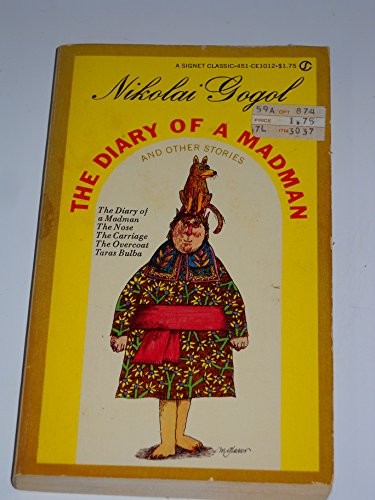
Diary of a Madman
Nikolai Gogol · 1809–1852 · Ukraine / Russia
Originally Zapiski Sumasshedshego (Russian)
Why it matters
A humiliated copying clerk's private notebook slides from wounded office pride into a private, escalating grandeur no one else can see. Gogol's interior monologue anticipates a century of unreliable narrators documenting their own collapse.
At a glance
Deteriorating, increasingly deranged diary entries mirror the narrator's collapsing grip on reality.
Deep dive
How a copying clerk's wounded pride over rank and an unrequited crush curdles into a private mythology only he can see, and what Gogol's diary form lets a reader watch happen from the inside.
Written for readers who have finished the book. No plot recap, and nothing here is safe to read first.
Themes & symbolism
Poprishchin is a titular councillor, the lowest rung with a claim to nobility under Peter the Great's Table of Ranks, and the diary format lets Gogol show rank anxiety operating beneath the level of conscious argument. He sharpens the director's quills, mocks under his breath, and measures every slight against men above him in grade, before the object of his devotion, the director's daughter Sophie, gives him an opening he invents rather than receives. The diary dates themselves start slipping and multiplying well before Poprishchin names a delusion outright, so a careful reader tracks his collapse through the calendar headers alone.
The two dogs, Fidèle and Medji, are the story's strangest device: Poprishchin claims to have intercepted their correspondence, and the letters he transcribes, full of catty gossip about Sophie's engagement to a chamberlain, let Gogol deliver plot information through a channel the narrator himself insists is real and the reader knows cannot be. That doubled unreliability, information arriving through an impossible source that is nonetheless accurate, is what makes the story a diagnosis of Poprishchin's mind rather than a satire aimed outward at Sophie's household.
The Vacant Spanish Throne and a Clerk's Logic
Poprishchin's delusion has a specific, real-world trigger: newspaper reports of Spain's disputed succession crisis of the 1830s, in which pretenders squabbled over a throne left vacant by Ferdinand VII. Poprishchin reads that no one currently occupies it and reasons, with the same clerkish literalism he brings to office memos, that a throne without an obvious claimant needs a claimant, and that he is as plausible a candidate as any Spaniard. The joke is structural: a man denied any real promotion invents the one promotion large enough that no one above him in the civil service could possibly outrank it. Gogol's surname for him even carries the argument: poprishche is the Russian word for a field of endeavor, a career path, so Poprishchin's very name is a small pun on a man defined entirely by the rank he never gets.
The last seal: what actually happens, and why it lands the way it does.
The ending, explained
Declared insane, Poprishchin is committed to an asylum he understands as the Spanish royal court, its cold baths and beatings recast in his diary as coronation rites and courtly hazing he must endure to prove his majesty. Gogol never breaks from Poprishchin's voice to correct him, so the reader has to supply the diagnosis the text withholds. The final entries lose their invented Spanish date stamps entirely and dissolve into direct address: a child's plea to his mother to save him, followed by the diary's last line, a non sequitur about whether the Bey of Algeria has a wart under his nose. That closing swerve away from the throne fantasy and toward his mother is the story's real admission, that underneath the grandeur is a much smaller, more ordinary suffering.
Where to go next
 Nikolai Gogol · 1835Taras BulbaLvl 4Fast paced
 Nikolai Gogol · 1836The NoseLvl 3Fast paced
 Nikolai Gogol · 1836The Government InspectorLvl 3Fast paced
 Nikolai Gogol · 1842Dead SoulsLvl 5Medium pace
 Nikolai Gogol · 1842The OvercoatLvl 3Medium pace
 Fyodor Dostoevsky · 1866Crime and PunishmentLvl 6Fast paced