
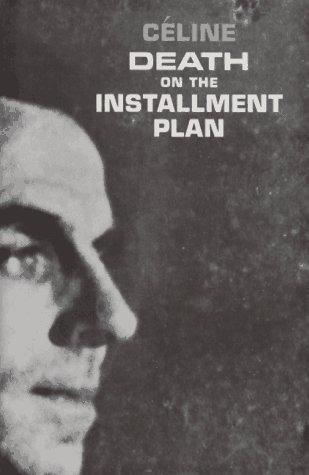
Death on the Installment Plan
Louis-Ferdinand Céline · 1894–1961 · France
Originally Mort à crédit (French)
Why it matters
A hallucinatory, scatological account of a Parisian boyhood among shopkeepers, quacks, and family catastrophe. Céline's prequel to Journey pushes his broken, breathless style even further.
At a glance
Hallucinatory, breathless, scatological prose pushed even further than its prequel.
Deep dive
Why Céline tells his own miserable childhood as a single unbroken shriek, three exclamation points at a time, instead of as the sentimental coming-of-age story it keeps threatening to become.
Written for readers who have finished the book. No plot recap, and nothing here is safe to read first.
Themes & symbolism
Ferdinand narrates his own childhood in the same overheated register whether he's describing a minor scolding or a catastrophe, his father Auguste's rages at the family's cramped rooms above the lace shop his mother Clémence keeps in the Passage des Bérésinas, and Céline's signature invention, the exclamation-heavy, ellipsis-riddled prose he called his petite musique, makes rage the book's actual subject rather than its decoration. Every sentence arrives already at full volume, which flattens the difference between real disaster and ordinary family friction until the reader can no longer tell which the narrator considers worse.
Sent to England to Meanwell College, ostensibly to learn the trade language his parents think will save him, Ferdinand instead watches the school's own genteel poverty and the headmaster's family collapse into the same shabby desperation he left behind in Paris, proof that the disorder Céline diagnoses isn't a Parisian problem or a family problem but a condition of the whole lower middle class scraping for dignity it cannot afford.
Courtial des Pereires, inventor, balloonist, and publisher of a crank science magazine, gives the second half of the book its real energy: a self-styled genius who cannot deliver on a single one of his schemes, from a publicity balloon ascent that nearly kills spectators to a doomed potato farm meant to run on a bogus telluric-current fertilizer method, and Ferdinand's apprenticeship under him is Céline's bleakest joke, that the boy finally finds a father figure only in a swindler even less competent than his own.
A Prequel Written Backward
Céline published this novel in 1936, two years after Voyage au bout de la nuit had already made him notorious, and wrote it as an origin story for that book's disgusted, wandering narrator: everything Ferdinand suffers here, the shop, the rages, Courtial's collapse, is the making of the man who narrates the earlier book's flight through war, colonial Africa, and industrial Detroit. Reading the childhood after the adulthood it produces turns the novel's chaos into an argument rather than just a catalogue, that Bardamu's disgust with the world didn't arrive from nowhere, Ferdinand's whole boyhood built it in him one humiliation at a time.
The last seal: what actually happens, and why it lands the way it does.
The ending, explained
Courtial's agricultural scheme collapses under debt and the contempt of the neighbors he has swindled, and rather than face the ruin of his last invention he takes a shotgun into a field and kills himself in front of Ferdinand, who is left to deal with the body and the wreckage of the commune alone. Ferdinand returns to Paris no wiser and no better provided for than when he left, and the novel closes without any of the redemptive arc its own title's grim joke, life as a debt paid off in fixed installments, would seem to promise, only the suggestion that Ferdinand's next chapter, the war Voyage au bout de la nuit opens with, is already waiting for him.
Where to go next
 Louis-Ferdinand Céline · 1932Journey to the End of the NightLvl 6Fast paced
 António Lobo Antunes · 1979The Land at the End of the WorldLvl 8Slow burn
 André Malraux · 1933Man's FateLvl 6Medium pace
 Raymond Queneau · 1959Zazie in the MetroLvl 5Fast paced
 Albert Camus · 1942The StrangerLvl 3Medium pace
 Jules Verne · 1870Twenty Thousand Leagues Under the SeaLvl 3Medium pace