
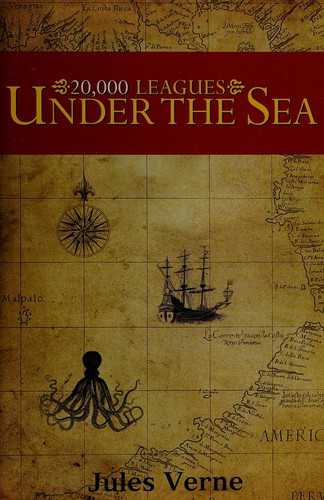
Twenty Thousand Leagues Under the Sea
Jules Verne · 1828–1905 · France
Originally Vingt mille lieues sous les mers (French)
Why it matters
Captain Nemo's submarine Nautilus glides beneath every ocean, encountering giant squid and sunken civilizations. Verne's fusion of hard technical speculation with pure wonder essentially invented modern science fiction's method.
At a glance
Straightforward adventure prose, slowed mainly by technical cataloguing.
Deep dive
A stateless genius builds a submarine to escape humanity entirely, and Verne spends the whole voyage asking whether that kind of freedom is actually a prison.
Written for readers who have finished the book. No plot recap, and nothing here is safe to read first.
Themes & symbolism
Captain Nemo is introduced as a marvel of self-sufficient genius — the Nautilus generates its own power, food, and air, and Nemo has renounced land, nationality, and human society entirely to live inside his own invention — but Verne steadily complicates the fantasy of total independence with glimpses of a man consumed by an unspecified grief and rage he never fully explains to Aronnax or the reader. The submarine's abundance (the undersea gardens, the organ, the museum of looted treasures) reads less like utopia than like a gilded cell Nemo has built for himself, technological mastery deployed in service of isolation rather than connection.
Verne's real subject across the voyage is less plot than inventory: extended cataloguing of fish species, ocean currents, coral formations, and geography reflects the nineteenth century's faith that the natural world was a total system awaiting complete scientific description, with Nemo's submarine as the ultimate instrument of that observational ambition. The novel's sense of wonder is scientific before it's adventurous — Aronnax's running commentary on marine taxonomy is presented with the same narrative weight as any action sequence, because for Verne, exhaustive knowledge of the world is itself the marvel.
Nemo's attack on a warship late in the voyage — revealed to be deliberate, sustained vengeance rather than an isolated act of self-defense — recasts everything that came before it: the man who seemed to have transcended human political grievance by abandoning land turns out to be driven by exactly the kind of national or personal injury (heavily implied, in Verne's original intention, to be colonial oppression, later made explicit as Indian in a sequel) that his underwater exile was supposed to have left behind. The Nautilus's freedom from every nation's laws makes Nemo simultaneously a genius liberated from human pettiness and an unaccountable power free to enact private justice on a scale no single man should have.
Verne's Anticipatory Science
Verne wrote the Nautilus's specifications with enough technical plausibility — electric propulsion, diving suits, distilled seawater — that later real submarine designers, including the US Navy's own nuclear submarine program, cited the novel directly; the first nuclear submarine was even named USS Nautilus in acknowledgment. That reputation for prophecy is part of why the novel endures past its Victorian scientific cataloguing: Verne wasn't simply imagining a fantastical machine but extrapolating carefully from real contemporary engineering, close enough that the fiction has repeatedly caught up with fact.
The last seal: what actually happens, and why it lands the way it does.
The ending, explained
After the Nautilus is drawn into the Moskstraumen, the great maelstrom off Norway's coast, during a violent storm, Aronnax, his servant Conseil, and the harpooner Ned Land — who have spent months as involuntary guests aboard the submarine, torn between scientific awe and the desire to escape — are thrown clear in a small boat and lose consciousness in the chaos, waking later safe on a Norwegian island with no memory of how they survived the whirlpool. The Nautilus's own fate, and Nemo's, are left explicitly unresolved: Aronnax can only speculate whether the submarine was destroyed or whether Nemo is still down there, sequestered in his 'abyss,' and Verne refuses to grant the reader the closure of a confirmed death or a redemption. The ambiguity is the point — Nemo's total withdrawal from human accountability was never going to end in a clean verdict, since the whole novel has been asking whether such a man can be judged by ordinary categories at all, and the maelstrom simply swallows the question along with the ship.
Where to go next
 Jules Verne · 1864Journey to the Center of the EarthLvl 3Fast paced
 Jules Verne · 1865From the Earth to the MoonLvl 3Medium pace
 Jules Verne · 1868In Search of the CastawaysLvl 3Fast paced
 Jules Verne · 1873Around the World in Eighty DaysLvl 2Fast paced
 Jules Verne · 1874The Mysterious IslandLvl 4Fast paced
 Raymond Queneau · 1959Zazie in the MetroLvl 5Fast paced