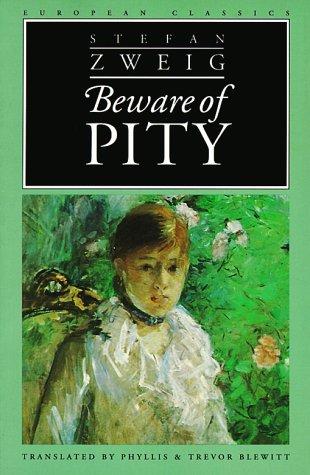
Beware of Pity
Stefan Zweig · 1881–1942 · Austria
Originally Ungeduld des Herzens (German)
Why it matters
A young cavalry officer's compassion for a paralyzed girl who loves him spirals from awkward kindness into engagement, deception, and disaster. Zweig's only completed novel dissects pity as a weakness disguised as virtue.
At a glance
Plain, confessional prose, though the narrator's self-justifications require a skeptical reader.
Deep dive
A cavalry officer's single, thoughtless request for a dance with a girl he doesn't realize is paralyzed sets off a chain of pity neither of them can stop escalating.
Written for readers who have finished the book. No plot recap, and nothing here is safe to read first.
Themes & symbolism
Anton Hofmiller, a young cavalry lieutenant garrisoned in a provincial Austro-Hungarian town before the First World War, asks Edith von Kekesfalva to dance at a party without realizing her legs are paralyzed, and his mortified apology the next day, flowers sent out of simple decency, draws him into the wealthy Kekesfalva household as a regular visitor. Zweig is precise about the mechanism: what starts Hofmiller's involvement is not attraction or even real sympathy but shame at his own tactlessness, and pity, once summoned, keeps generating obligations no single kind act can discharge.
Edith and her father Lajos mistake the lieutenant's compulsive visits for love, and Hofmiller, too cowardly to correct a misunderstanding that is making a dying, desperate household happy, lets himself be drawn into an engagement he never wanted and cannot bring himself to refuse to Edith's face. His subsequent denial of that same engagement to fellow officers, blurted out of pure social shame rather than any change of heart, is the novel's real catastrophe, a second betrayal built entirely out of the same weak impulse, avoiding an uncomfortable feeling in the moment, that produced the first.
Zweig's Only Full-Length Novel
Zweig built his reputation on novellas, Chess Story, Letter from an Unknown Woman, and Beware of Pity, published in 1939 after Zweig had already fled Vienna following the 1938 Anschluss, is the sole complete novel in his output. Its portrait of a doomed, gracious Habsburg world sliding unknowingly toward 1914 reads as a double elegy, for the pre-war Europe the book depicts and for the Austria Zweig had just lost a second time, in exile, as he wrote it; he and his wife would take their own lives in Brazil in 1942, three years after the book's publication.
A Confession Told to a Stranger
Zweig frames the entire novel as Hofmiller's confession, delivered decades later to an unnamed writer he meets by chance, and that distance changes what the pity story means: an old man is still working out, years afterward, how a single thoughtless kindness curdled into the worst thing he ever did. The frame never lets the reader forget that Hofmiller has had a lifetime to rehearse this account and still cannot make it come out as anything other than his own failure of nerve.
The last seal: what actually happens, and why it lands the way it does.
The ending, explained
Hofmiller's public denial of the engagement reaches Edith before he can take it back, and she throws herself from a tower window that same night, her death arriving just as the war that will consume the empire around her is beginning. Hofmiller, transferred to the front, earns a medal for a reckless act of bravery that the narrative frames less as heroism than as a man trying, half-deliberately, to get himself killed in payment for what his cowardice did to Edith. He survives the war anyway, and the frame narrator closes the book noting only that Hofmiller has never told this story to anyone else, an old wound finally, once, spoken aloud rather than resolved.