
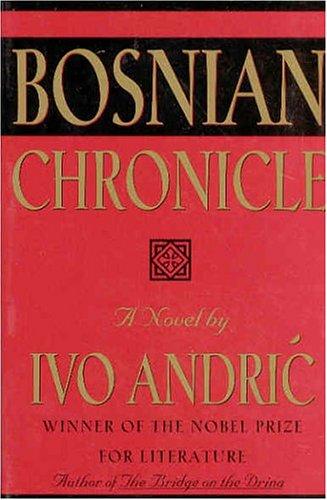
Bosnian Chronicle
Ivo Andrić · 1892–1975 · Yugoslavia / Bosnia
Originally Travnička Hronika (Serbo-Croatian)
Why it matters
A French consul stationed in Ottoman-era Travnik navigates a decade of Balkan intrigue, isolation, and cultural collision. Andrić's other great historical epic, published the same year as The Bridge on the Drina.
At a glance
A single steady consular viewpoint carries a long but clearly narrated historical chronicle.
Deep dive
Two European consuls take up posts in an Ottoman garrison town that has no interest in Napoleon, and Andrić spends the whole novel measuring the distance between the history happening in the rest of the continent and the history that actually registers here.
Written for readers who have finished the book. No plot recap, and nothing here is safe to read first.
Themes & symbolism
Jean Daville, France's newly appointed consul to the Bosnian vilayet capital of Travnik, arrives in 1807 an idealist, a former revolutionary poet who has come to believe in the civilizing reach of Napoleon's Europe, and Andrić builds the entire novel around watching that belief erode across seven years of tedious, thankless negotiation with a suspicious Ottoman court and a local population that regards both Daville and his Austrian rival von Mitterer as interchangeable foreign irritants rather than representatives of anything worth taking seriously. The vizier's palace cycles through several occupants during the consuls' tenure, each new appointee arriving with fresh promises and leaving under the same cloud of Ottoman decline, and the turnover itself becomes the novel's real subject: European history registers here only as a rumor that occasionally interrupts a much older, slower local rhythm.
Andrić, who served as a Yugoslav diplomat himself before writing the novel in near-total seclusion during the German occupation of Belgrade, gives Daville and von Mitterer opposing temperaments rather than opposing interests, Daville's residual Enlightenment idealism fraying against the plain careerist realism of his Austrian counterpart, and lets both postures fail equally against a town that has outlasted a dozen occupying visions of itself before either man arrived and will outlast theirs too. Both wives, Daville's and von Mitterer's, are dragged along on postings neither chose and neither can leave, and Andrić extends the same patient, unglamorous attention to their isolation that he gives the consuls' diplomacy, a domestic front to the larger argument about how little control any outsider actually has here.
A Vizier's Office With a Revolving Door
Travnik cycles through several Ottoman viziers over the course of the novel, each arriving with retinues and reforms and departing, usually abruptly, as Constantinople's own instability ripples outward to its provinces. Andrić uses the turnover as a structural clock distinct from the consuls' own calendar: European chronology moves through Napoleon's campaigns and reversals, while Bosnia's actual governing rhythm is set by a much less legible cycle of Ottoman appointments the consuls can never quite predict or influence.
The novel's original title translates more literally as the Travnik Chronicle, and the word chronicle is doing real work: Andrić withholds the shaping devices of conventional plot, climax, reversal, resolution, in favor of a chronicler's patience, years passing in paragraphs, minor officials arriving and dying and being replaced, so that the town's persistence itself becomes the only narrative arc the book is willing to offer.
Where to go next
 Ivo Andrić · 1945The Bridge on the DrinaLvl 4Slow burn
 Meša Selimović · 1966Death and the DervishLvl 6Slow burn
 Vasily Grossman · 1980Life and FateLvl 7Medium pace
 Danilo Kiš · 1976A Tomb for Boris DavidovichLvl 7Medium pace
 Mikhail Sholokhov · 1928And Quiet Flows the DonLvl 5Medium pace
 Bolesław Prus · 1890The DollLvl 5Medium pace