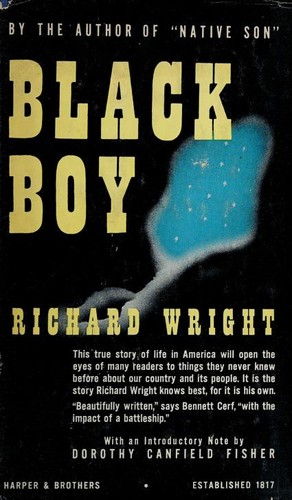
Black Boy
Richard Wright · 1908–1960 · United States
Why it matters
Wright's autobiography narrates a childhood of hunger, violence, and intellectual hunger in the Jim Crow South. As much indictment as memoir, and one of American autobiography's essential texts.
At a glance
Direct, chronological memoir prose.
Deep dive
Wright narrates his own Mississippi and Memphis childhood as a slow education in hunger, fear, and the exact words the Jim Crow South did not want a Black boy to learn.
Written for readers who have finished the book. No plot recap, and nothing here is safe to read first.
Themes & symbolism
The memoir begins on literal hunger, young Richard's stomach cramping through the day because his mother can't reliably feed him and his younger brother after their father abandons the family, and hunger stays the book's central image even as it stretches to cover everything Richard is denied: books, tenderness, a self not constantly under surveillance. His grandmother's rigid Seventh-day Adventism turns the household itself into another site of discipline, beatings delivered for perceived sins, hymns and prohibitions policing Richard nearly as thoroughly as the white world outside ever does, so that the memoir's first violent education happens well before he ever has to reckon with Jim Crow directly.
Language becomes the one form of power Richard can actually seize inside a system built to keep Black literacy limited, suspect, even dangerous to display. When a local Black newspaper publishes one of his stories, the reaction from his own family and neighbors is bewilderment bordering on alarm, ambition itself read as a threat to survival rather than an achievement, since a Black boy with visible intellectual hunger was exactly what Jim Crow Mississippi was organized to suppress. Wright is explicit that the South taught him to fear his own curiosity long before it taught him anything about books.
The Library Card Scheme
Barred from borrowing books as a Black patron, Richard forges a note claiming to fetch novels on behalf of a white coworker, and walks out of the Memphis library with H. L. Mencken's A Book of Prefaces under his arm. Mencken's prose, attacking Southern gentility and using language as an open weapon, hits Richard as a revelation: that words themselves could be aimed at power rather than merely used to survive it. The scene reads less like a nostalgic reading-awakening than a heist, deliberate deception as the only available route to literacy the South was actively working to deny him.
Two Souths, One House
Wright is careful to locate real violence inside his own family alongside the white world's, his grandmother's beatings, his Uncle Tom's attempt to physically discipline him for insufficient deference, a household that enforced caution as a survival mechanism and experienced Richard's growing individuality as recklessness that endangered everyone around him. The memoir refuses to separate these into a simple Black interior warmth against white exterior cruelty. Both systems, Wright argues, were shaped by the same terror, and both ultimately taught him the same lesson: that surviving the South meant learning to make himself smaller than what he actually was.
The last seal: what actually happens, and why it lands the way it does.
The ending, explained
The book, published as Wright originally intended only its Southern half (the Chicago material he wrote to follow it was cut before publication and only restored decades later as American Hunger), closes with nineteen-year-old Richard boarding a train out of Mississippi for Chicago, carrying almost nothing material and a hope that is entirely unverified by anything the narrative has shown him. He describes wanting to build a meaning for his life that the South had made structurally impossible, using words themselves as the tool. Wright doesn't claim the North will actually deliver on that hope, only that leaving is the precondition for finding out, an ending pitched as a beginning rather than a resolution.