
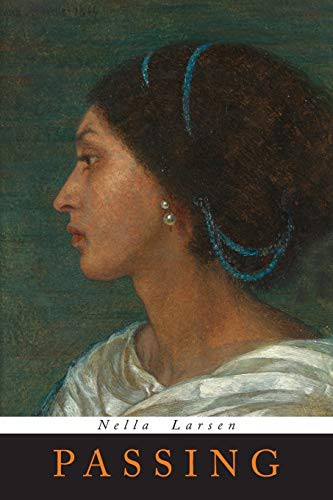
Passing
Nella Larsen · 1891–1964 · USA
Why it matters
Two light-skinned Black women, one living as white, circle each other with mounting fascination, envy, and danger across 1920s Harlem and Chicago. A hundred pages of controlled ambiguity: race, desire, and threat braided so tightly critics still argue what finally happens between them.
At a glance
Short and controlled, but its ambiguous ending demands careful rereading.
Deep dive
A close reading of what this novel refuses to resolve at its climax, and the machinery of denial that keeps its narrator — and its readers — from ever fully trusting what she says she saw.
Written for readers who have finished the book. No plot recap, and nothing here is safe to read first.
Themes & symbolism
"Passing" stages two kinds of racial performance and treats only one of them as dangerous. Clare's passing is total and material — she has built a marriage, a household, and a self on Jack Bellew's ignorance, and the scene where he calls her "Nig" as an endearment while joking that he'd never let "a nigger" near their family is the novel's coldest joke: dramatic irony delivered as domestic comedy, with both women in the room and Bellew oblivious to what he is actually saying and to whom. But Larsen is at least as interested in Irene's smaller, more respectable passing — for security, for propriety, for a marriage and a class position she is terrified of losing — and the plot punishes that composure by handing her, in Clare, a mirror she cannot stop looking into. Envy, not curiosity, is what pulls Irene back to Clare after every resolution to cut her off, and the novel lets that envy shade into desire without ever using the word, so that Irene's fixation on Clare's beauty, recklessness, and nerve reads simultaneously as racial anxiety, class anxiety, and something closer to longing.
The narration never leaves Irene's head, which means every account of Clare's motives, Brian's fidelity, and the danger Clare supposedly poses is Irene's interpretation and nothing else is ever confirmed. The suspected affair between Clare and Brian is never verified by the text — only by Irene's mounting, self-interested suspicion — which means the entire back half of the novel is a jealousy plot Irene may have partly invented, its evidence assembled by a narrator with every motive in the world to see Clare as a threat worth removing.
A Style Built on Restraint
Larsen writes in the same controlled, decorous register her characters are policing themselves with — short scenes, precise social observation, almost no interiority spelled out directly — so that the prose itself performs the discipline passing, in both its racial and social sense, requires. The effect is a novel that reads like a comedy of manners for roughly its first half and only gradually reveals the violence underneath the manners: every tea party and dinner exchange in Harlem's Black professional class carries the same risk of exposure that governs Clare's marriage, just at lower stakes, so that by the time Bellew arrives at the final party, a hundred pages of drawing-room control have trained the reader to expect exactly the eruption that comes.
The title itself is doing two things at once, and the novel earns the second meaning only at the very end. "Passing" names Clare's racial performance throughout, but the word's other sense, passing away, sits dormant until the final page reactivates it, quietly binding the book's whole study of racial self-erasure to the literal death that closes it — as if the risk Clare has been living with the entire novel was always going to cash out as exactly this.
The last seal: what actually happens, and why it lands the way it does.
The ending, explained
Bellew's arrival, likely after discovering or guessing at Clare's ancestry, triggers the one moment of true chaos in a novel that has otherwise been glacially controlled; Clare falls from the window an instant later, and Larsen places Irene close enough beside her that the reader is given, and then instantly denied, the clearest possible view of what happened. Did Bellew push her. Did Clare jump, choosing the end of exposure on her own terms rather than live out whichever life was about to be destroyed. Did Irene, in one lunge of pure panic and self-preservation, push the one person who could unmake her own carefully built life. Larsen never lets Irene's own account settle into a stable answer — the narration blurs and rationalizes, as if it cannot bear to look directly at itself — and the novel closes there deliberately: what really happened is inseparable from whether Irene can be trusted to say.
Where to go next
 Nella Larsen · 1928QuicksandLvl 5Medium pace
 Richard Wright · 1940Native SonLvl 5Fast paced
 James Baldwin · 1956Giovanni's RoomLvl 5Medium pace
 Ralph Ellison · 1952Invisible ManLvl 7Medium pace
 Zora Neale Hurston · 1937Their Eyes Were Watching GodLvl 5Medium pace
 Italo Svevo · 1923Zeno's ConscienceLvl 6Medium pace