
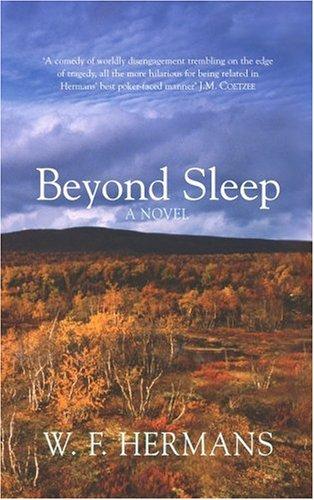
Beyond Sleep
W. F. Hermans · 1921–1995 · Netherlands
Originally Nooit meer slapen (Dutch)
Why it matters
A geology student treks into arctic Norway chasing a doctoral thesis on meteor craters and unravels amid exhaustion, rivalry, and farce. Hermans's bleakly comic study of ambition curdling into futility.
At a glance
Clear prose, but mounting absurdity and irony reward sustained attention.
Deep dive
Why a geology student's Arctic thesis expedition, doomed from the packing list onward, becomes Hermans's bleakest comedy about ambition.
Written for readers who have finished the book. No plot recap, and nothing here is safe to read first.
Themes & symbolism
Alfred Issendorf sets out for Finnmark in the far north of Norway to locate meteor craters for his doctoral thesis, working from photographs and a theory borrowed partly from his own dead father, a renowned scientist whose reputation Alfred has spent his career trying to live up to without ever matching. Hermans stacks the deck against him from the packing list forward: the wrong maps, borrowed equipment that doesn't fit the terrain, a camera that turns out to have no film in it, so the expedition is compromised before anyone has walked a single mile.
The international team Alfred joins, Norwegian, Swedish, and Irish researchers who share the trek but not his sense of mission, treat the search with a professional detachment Alfred can't manage, and the gap between his private, almost religious investment in finding the craters and his colleagues' shrugging competence becomes the novel's real comedy: everyone else is just doing a job, and Alfred alone has made the outcome a referendum on his entire worth as a person and as his father's son.
Sleep deprivation, present from the title onward, functions less as physical detail than as narrative logic: Alfred's judgment erodes across the trek in ways he can't track from inside his own exhaustion, and Hermans lets the prose itself go slightly unreliable along with him, small errors and misreadings accumulating the way they would in an overtired mind, until the reader trusts Alfred's account of events noticeably less by the book's second half than its first.
A Rifle Shot That Was Never About a Bear
Late in the trek, a companion fires a rifle shot at what he claims was a bear, and the incident, ambiguous, possibly a genuine threat, possibly a symptom of the whole party's fraying nerve, becomes the closest the novel comes to real physical danger without ever confirming whether the danger was real. Hermans refuses to resolve it, and the refusal fits a novel built entirely around the gap between what a rational scientific expedition believes it's tracking and what its exhausted members actually experience out on the tundra.
The last seal: what actually happens, and why it lands the way it does.
The ending, explained
Alfred never finds the meteor craters: the geology doesn't support his father's theory, another member of the expedition finds something more conventionally publishable, and Alfred limps home having proven nothing except his own capacity for elaborate, well-organized failure. Hermans denies him any of the grace a redemption arc would offer, no consolation-prize insight, no reconciliation with his father's memory, just the return trip and the flat prospect of writing up a thesis with nothing in it. The bleakness is the joke: an entire genre of scientific-quest narrative gets played straight right up until the moment it should deliver a discovery, and instead delivers Alfred, alone, having lost some equipment, a camera's worth of blank film, and a great deal of sleep, all of it for nothing he can write down.
Where to go next
 W. F. Hermans · 1958The Darkroom of DamoclesLvl 5Medium pace
 Gerard Reve · 1947The EveningsLvl 4Slow burn
 Cees Nooteboom · 1980RitualsLvl 6Slow burn
 Harry Mulisch · 1992The Discovery of HeavenLvl 6Medium pace
 Hugo Claus · 1983The Sorrow of BelgiumLvl 6Medium pace
 Cesare Pavese · 1950The Moon and the BonfiresLvl 6Slow burn