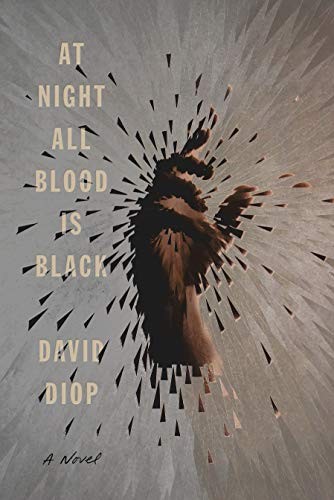
At Night All Blood Is Black
David Diop · b. 1966 · France
Originally Frère d'âme (French) · translated by Anna Moschovakis
Why it matters
After failing to grant his wounded childhood friend a merciful death, Senegalese tirailleur Alfa Ndiaye begins crossing the wire nightly to collect German hands. The first French novel to win the International Booker: WWI's colonial soldiers given voice at last.
At a glance
Short but harrowing; incantatory refrains and ritual violence build an unbroken trance.
Deep dive
What it means that a novel about mutilated hands is narrated by a voice that keeps insisting on its own honesty.
Written for readers who have finished the book. No plot recap, and nothing here is safe to read first.
Themes & symbolism
French colonial propaganda marketed the tirailleurs sénégalais to German troops as savage, machete-wielding figures to be feared — a racist caricature designed to terrorize the opposing trenches — and Alfa Ndiaye, undone by his failure to grant his dying friend Mademba Diop a mercy killing, begins to perform that caricature literally, crossing into no-man's-land after dark to kill soldiers and take a hand as trophy. The horror indicts the propaganda that invented the image in the first place: the 'monster' the French army marketed for its own psychological-warfare purposes turns out to be a role a grieving man can be driven to actually inhabit. His fellow soldiers cheer the first few hands as heroism, in keeping with the myth they've all been sold, then recoil once the tally exceeds what's socially legible — exposing the whole economy of racialized battlefield valor as contingent, and as cruel to the men asked to embody it.
Diop builds the narration out of insistent, incantatory repetition — phrases like 'I know, I understand' and 'God's truth' recur almost as call-and-response — so the prose reads less like conventional first-person confession than like oral testimony, circling the same unbearable scene (Mademba's slow, disemboweled death, and Alfa's refusal to end it quickly) the way a mind stuck in trauma actually circles it. The device does double duty: it reproduces obsessive guilt formally, and it roots the novel in West African oral storytelling traditions rather than the linear conventions of the European war novel it's ostensibly working within.
Incantation, Repetition, and the Griot's Voice
The repeated refrains that structure Alfa's narration draw on the rhythms of griot storytelling and Wolof oral tradition, in which repetition builds meaning cumulatively rather than through linear disclosure — a technique Anna Moschovakis's English translation preserves rather than smooths over. Read against the European trench-literature tradition it's formally in conversation with (Barbusse, Remarque), the effect is pointed: a colonial soldier's story, refused a voice by the history that used and discarded him, is told back in a form that history never controlled. Mademba himself functions less as a rounded character than as the hinge the whole book turns on — Alfa describes him, insistently, as 'more than a brother,' a bond the narration returns to so often that his death reads less like the loss of one friend than like the amputation of half of Alfa's own identity.
The last seal: what actually happens, and why it lands the way it does.
The ending, explained
Alfa's nightly hand-taking escalates until the men who once cheered him come to fear him as something other than a soldier, and he is eventually pulled from front-line duty and sent to a rear-area hospital, where the novel's final movement deliberately blurs psychological breakdown with the folkloric transformation the narration has been gesturing toward throughout — Senegalese tradition's dëmm, a soul-devouring sorcerer capable of taking other forms. Diop declines to settle which register, clinical trauma or supernatural metamorphosis, is the 'true' one; the ambiguity is the point, refusing the reader a tidy diagnosis for what colonial war has made of Alfa.