
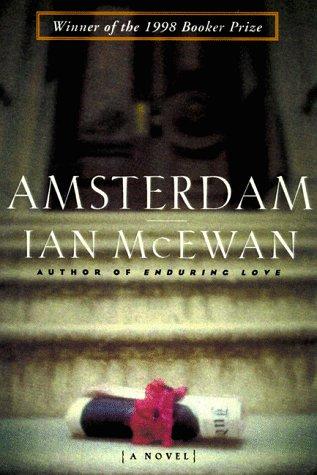
Amsterdam
Ian McEwan · b. 1948 · England
Why it matters
Two old friends at a former lover's funeral strike a grim pact about how to handle each other's decline, a bargain neither man's vanity can quite be trusted to honor. McEwan's compact, blackly comic Booker winner turns friendship into a duel.
At a glance
A tight, fast, compact plot told in clean, controlled prose.
Deep dive
Two old friends make a well-meaning pact at a funeral about how they'd want to go — and McEwan spends the rest of the novel testing exactly how far a wounded vanity will stretch that promise to cover something much uglier.
Written for readers who have finished the book. No plot recap, and nothing here is safe to read first.
Themes & symbolism
The euthanasia pact Clive Linley and Vernon Halliday casually strike at Molly Lane's funeral — that if either man is ever reduced to the kind of degrading, mindless decline that killed Molly, the other will help him die with dignity in Amsterdam, where the law allows it — is set up as an act of loyal, humane friendship and gradually revealed as something closer to two vain men's mutual insurance policy against ever seeming diminished. McEwan structures the whole novel to demonstrate that the pact's generous language survives intact right up until each man needs a justification for something closer to murder.
Clive's crisis of conscience on a Lake District walk — witnessing what looks like an assault in progress and choosing not to intervene because interrupting would break his composing concentration on a commission for the Millennial Symphony — and Vernon's decision to destroy a former cabinet minister's career by publishing private photographs of him in women's clothing are constructed as parallel moral failures, each man convincing himself his own transgression serves a higher professional or public purpose while being appalled by the other's. McEwan's satire targets a specifically British establishment vanity: both men are certain of their own moral superiority and use it to license exactly the kind of self-interested cruelty they claim to be above.
Julian Garmony, the foreign secretary Vernon tries to destroy over the cross-dressing photographs, survives the scandal essentially unscathed and, by the novel's end, positioned to become prime minister — McEwan's bleakest joke, since the one character willing to weather public exposure and brazen it out ends up rewarded, while the two friends who spent the novel manufacturing high-minded justifications for their own betrayals destroy each other instead.
A Slim Satire, A Surprising Booker
Amsterdam won the 1998 Booker Prize despite being widely regarded, including by some of McEwan's own admirers, as a minor entry in his body of work compared to Atonement, published just three years later — a reception that turned the prize into something of a running joke about the Booker rewarding a lesser book from a major novelist rather than his best work. McEwan's own defense of the novel rests on its precision as a compact black comedy of manners: at under two hundred pages, it has none of the sprawl of his more acclaimed novels, trading depth of feeling for a tightly engineered satire of upper-middle-class English self-regard.
The last seal: what actually happens, and why it lands the way it does.
The ending, explained
Each convinced the other has become dangerously unstable — Clive appalled by what he reads as Vernon's unhinged vindictiveness toward Garmony, Vernon convinced Clive's refusal to help the assault victim proves a serious moral and mental collapse — both men independently and secretly invoke their funeral pact against each other, each arranging with a compliant Amsterdam clinic to have the other quietly euthanized under the pretense of a shared holiday and reconciliation. At a hotel toast meant to celebrate patching up their friendship, each has drugged the other's champagne; both men die within minutes, watched by hotel staff who assume a medical emergency, each dying believing he was administering a barely-late mercy to a friend past saving while in fact being murdered by that same friend for identical reasons. Molly's widower George Lane and the disgraced-but-surviving Garmony travel to Amsterdam together to collect the bodies, closing the novel on the driest possible irony: the marriage of convenience between the two men left standing, neither of whom the reader has any reason to admire, inherits the field entirely by default.
Where to go next
 Ian McEwan · 2001AtonementLvl 5Medium pace
 Pat Barker · 1991RegenerationLvl 4Medium pace
 Penelope Lively · 1987Moon TigerLvl 6Medium pace
 Graham Swift · 1996Last OrdersLvl 5Medium pace
 Julian Barnes · 2011The Sense of an EndingLvl 4Medium pace
 Muriel Spark · 1961The Prime of Miss Jean BrodieLvl 4Fast paced