
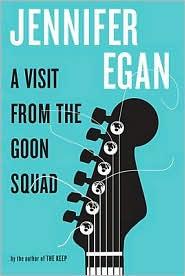
A Visit from the Goon Squad
Jennifer Egan · b. 1962 · United States
Why it matters
Musicians, publicists, and their children are tracked across decades in a novel-in-stories, one chapter told entirely in PowerPoint slides. Won the Pulitzer for its structural daring in rendering time's passage.
At a glance
Fractured, non-chronological structure jumps narrators, decades, even a slideshow chapter.
Deep dive
Why the book that keeps jumping decades and formats refuses to end where it started, and what a slide-deck chapter is doing inside a literary novel.
Written for readers who have finished the book. No plot recap, and nothing here is safe to read first.
Themes & symbolism
Egan's title line — "time's a goon, right? You gonna let that goon push you around?" — supplies the thesis the whole novel's structure is built to prove: nobody outruns it. Punk kleptomaniac Sasha becomes a suburban mother anxiously cataloging her own family's normalcy; her old boss Bennie, once a visionary producer chasing 'pure' sound out of garage shows, ages into a man selling nostalgia to an industry that's algorithmically flattened the difference between authentic and manufactured. The novel refuses linear chronology on purpose, vaulting decades forward and backward chapter to chapter and handing the narrative baton to minor characters from earlier stories, because a single timeline would let the reader mistake decline for a plot rather than recognizing it as the ambient condition every character in the book is living inside.
The music industry itself functions as the novel's clearest symbol for time's erosion of authenticity: punk's raw noise curdles into corporate playlists, PR flacks rehabilitate genocidal dictators using the same tactics they'd use to launder a pop star's image, and even rebellion becomes a packageable aesthetic the moment someone figures out how to monetize it. Egan's structural gimmick — a chapter rendered entirely as a child's PowerPoint slides, charting her family's dynamics and her autistic brother's obsession with the pauses in classic rock songs — isn't a stunt so much as the book's argument taken to its formal limit: if content keeps getting repackaged into whatever format sells, the novel itself should be willing to become one of those formats rather than merely describing them from outside.
The Slide-Deck Chapter
Alison's PowerPoint chapter tracks her brother's cataloging of 'great rock and roll pauses' — the deliberate silences in songs by the Who, Journey, Pink Floyd — and turns those pauses into a metaphor for everything the novel leaves unsaid between its jump cuts. The chapter's visual, fragmentary logic mimics how a child processes family anxiety in bullet points and charts rather than paragraphs, and it lands as the book's most sincere passage precisely because its form looks like the least literary thing in it, a joke that Egan refuses to play for laughs.
A Novel Structured Like a Network, Not a Line
No single character carries the book; instead, each chapter tunnels sideways into a minor figure glimpsed in a previous one, so the novel accumulates like a social network rather than a plot — a structure that anticipates, and quietly critiques, the very platforms later chapters imagine colonizing music, memory, and even parenthood with data and metrics. Reading it in page order versus reading it by internal chronology produces two different, equally valid books, which is Egan's point: there was never one true timeline to betray, only a crowd of people the goon eventually gets to, each on their own clock.
Where to go next
 Hernán Diaz · 2022TrustLvl 6Medium pace
 Percival Everett · 2001ErasureLvl 6Fast paced
 László Krasznahorkai · 1985SatantangoLvl 9Slow burn
 Roberto Bolaño · 1998The Savage DetectivesLvl 7Medium pace
 Guillermo Cabrera Infante · 1967Three Trapped TigersLvl 9Slow burn
 Péter Esterházy · 2000Celestial HarmoniesLvl 8Slow burn