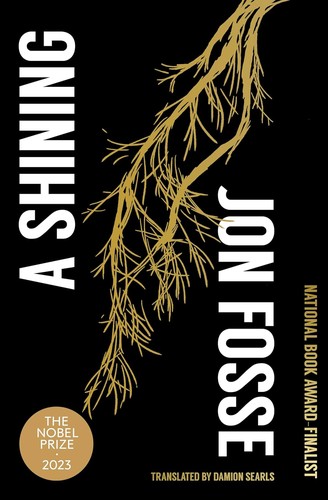
A Shining
Jon Fosse · b. 1959 · Norway
Originally A Shining (Norwegian) · translated by Damion Searls
Why it matters
A man's car breaks down on a forest road at dusk, and what follows dissolves into something between vision and death. A short, luminous late work distilling Fosse's lifelong preoccupation with light beyond ordinary sight.
At a glance
Short but hallucinatory, dissolving the line between event and vision.
Deep dive
What a man finds in the forest after driving off the road for no reason he can explain to himself, and why Fosse refuses to say whether it is comfort, memory, or something closer to an ending.
Written for readers who have finished the book. No plot recap, and nothing here is safe to read first.
Themes & symbolism
The nameless narrator turns off a familiar road on impulse, drives into a forest until his car sticks fast in snow, and keeps walking rather than turning back, a decision the novel never bothers to motivate because Fosse's late style treats crisis as something that arrives without cause rather than something a plot builds toward. The aimlessness is the point: nothing forces this man off the road except an impulse he cannot name, and Fosse's flat, repetitive, semicolon-heavy sentences make that driftlessness feel less like carelessness than like a kind of prayer with no address yet. Fosse writes in Nynorsk, the minority written form of Norwegian, and the choice carries its own quiet argument, that a marginal, rural register is exactly the right instrument for a vision this unassuming.
Deep in the woods, the narrator's long-dead parents appear and speak to him in exactly the querulous, ordinary tones of a living, bickering couple, no ghostly gravity, no unfinished business speech, just his mother fussing and his father mildly irritated, and the mundanity is what makes the scene devastating rather than the reverse. Fosse refuses every convention of the literary ghost, grief here is not a wound reopened dramatically but a return so plain it briefly convinces the reader nothing supernatural is happening at all. They correct each other's memories of small, decades-old arguments as the walk continues, and the effect trades the tearful reunion the scene seems to promise for something closer to mild, familiar irritation carried past the grave.
A Conversion Written Into the Prose Itself
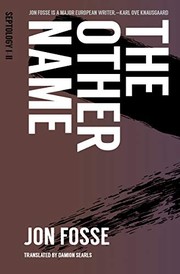
Fosse converted to Catholicism in his fifties, after decades as a nonpracticing Lutheran, and the slow, incantatory, comma-driven sentences of his late work, most fully developed across the seven-volume Septology, read as a formal argument for faith as much as a subject of it: meaning arrived at by accretion and repetition rather than by plot, the reader worn into a state closer to devotion than analysis. This short novel condenses that method to its most stripped-down form, a single unbroken walk toward a light that the prose never allows itself to name outright. Fosse has resisted calling that light God even in interviews, preferring to let the word 'shining' carry the theological weight his characters cannot quite say aloud, a reticence that runs through the whole of his late religious fiction.
The last seal: what actually happens, and why it lands the way it does.
The ending, explained
The narrator keeps walking toward a white shining he cannot look away from, the cold worsening around him without the novel ever returning him to the stuck car or to any ordinary rescue. Fosse gives no clear signal of death, no last collapse, only the light growing closer and more total as the pages run out, so the ending sits deliberately between three readings the book refuses to rank: a mystical vision, a hypothermic hallucination, or an actual crossing into whatever comes after, the shining doing duty as God, death, and homecoming all at once without picking one.