
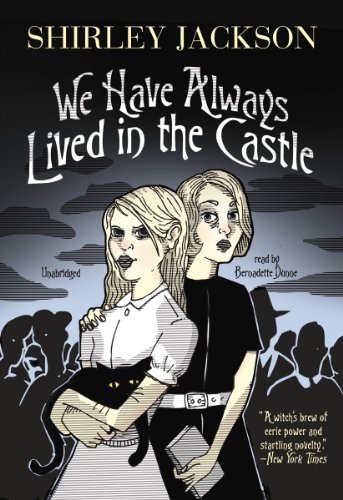
We Have Always Lived in the Castle
Shirley Jackson · 1916–1965 · United States
Why it matters
Two sisters live sealed away from a hostile village after a family poisoning, one of them narrating with eerie calm. Jackson's masterpiece of the domestic uncanny: 'The Lottery' grown into a whole strange world.
At a glance
Deceptively simple, eerie narration hides a slow-building unreliable perspective.
Deep dive
Two sisters, sealed away in a hostile village six years after a family poisoning, narrated by the younger one's eerily calm rituals of protection — Jackson's masterpiece of the domestic uncanny, grown out of the same instincts as 'The Lottery.'
Written for readers who have finished the book. No plot recap, and nothing here is safe to read first.
Themes & symbolism
The novel's central engineering trick is that Merricat narrates with such calm, matter-of-fact confidence in her own rituals — burying objects, nailing books to trees, reciting private words to ward off danger — that most readers accept her as merely eccentric long before the book discloses, well past its midpoint, that she herself, at twelve, put the arsenic in the sugar bowl that killed the rest of the family, choosing the bowl specifically because she knew her sister Constance never touched sugar. That revelation recasts everything preceding it: Merricat's magical thinking is not a quirky narrative device but an ongoing, never-consciously-acknowledged negotiation with buried guilt, a child's logic she has never had to outgrow because Constance has spent six years silently absorbing the village's suspicion and a murder trial in her place, protecting her sister out of a love that asks no questions and expects no confession.
Jackson, writing at a moment of real anxiety about conformity and community surveillance she had already explored in "The Lottery," builds the surrounding village's casual, escalating cruelty toward the Blackwood sisters — children's taunting rhymes, adults' pointed unfriendliness, a townful of people who have decided guilt by unproven association is close enough to guilt — into a portrait of how easily a community closes ranks against anyone marked as different or suspect, regardless of what can actually be proven against them. Uncle Julian, frail and confused, occupies an unsettling middle position in this economy of memory: his obsessive, repetitive attempts to write an exhaustive account of the poisoning day keep circling the true event without ever quite landing on it, embodying the gap between what actually happened and what the survivors, including Merricat herself, can bear to consciously know.
A Fairy Tale With a Horror Underneath It
Jackson gives the sisters' eventual retreat into an ever-smaller, self-sufficient world the shape of a fairy tale rather than straightforward tragedy, and that tonal choice is the novel's most audacious move: Merricat and Constance's devotion to each other, whatever crime it was built to protect, is presented as the one wholly real, sustaining thing in the book, so their isolation reads simultaneously as a life stunted by trauma and as something the narrative allows to feel like a happy ending on its own terms. Jackson had drafted the novel while dealing with severe agoraphobia and anxiety of her own in the last years of her life, and the sisters' contentment inside their shrinking, damaged house has often been read as her most direct fictional expression of finding safety, even flourishing, precisely by withdrawing from a world that has already made clear it will not be kind.
The last seal: what actually happens, and why it lands the way it does.
The ending, explained
Cousin Charles arrives transparently chasing the family's remaining money, ingratiating himself with Constance while treating Merricat with open contempt, and Merricat's escalating campaign against him culminates in a fire, set through her own chaotic, magical-thinking logic turned catastrophically literal, that burns much of the house and drives Charles off for good. The blaze also draws the whole hostile village, whose suppressed resentment erupts into looting and vandalizing the family's remaining possessions once the fire crews arrive, and Uncle Julian dies amid the chaos. In the aftermath, Merricat and Constance retreat into the blackened shell of their home, sealing themselves in even more completely than before, while the same villagers, in a strange, guilt-ridden reversal, begin leaving food offerings at their doorstep. The sisters accept the gifts as both tribute and continued exile, and Jackson closes on the two women achieving a genuinely inseparable, self-contained completeness that reads as equal parts horror and fairy-tale contentment.
Where to go next
 Shirley Jackson · 1959The Haunting of Hill HouseLvl 5Fast paced
 E. T. A. Hoffmann · 1816The SandmanLvl 6Medium pace
 Nathaniel Hawthorne · 1850The Scarlet LetterLvl 7Slow burn
 Carson McCullers · 1940The Heart Is a Lonely HunterLvl 5Medium pace
 Peter Taylor · 1986A Summons to MemphisLvl 5Slow burn
 Richard Wright · 1940Native SonLvl 5Fast paced