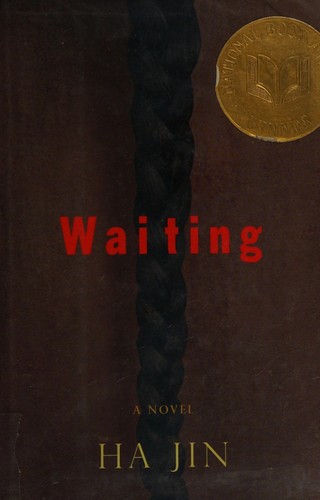
Waiting
Ha Jin · b. 1956 · China / United States
Why it matters
A Chinese army doctor waits eighteen years for a divorce to marry the nurse he loves, only to discover freedom isn't what patience promised. Ha Jin's National Book Award winner renders Communist-era bureaucracy and desire with spare, exacting restraint.
At a glance
Plain, restrained prose carries a slow-building eighteen-year story.
Deep dive
Why the real subject of Ha Jin's novel is what eighteen years of institutionalized patience does to the people living inside it, not whatever verdict finally arrives.
Written for readers who have finished the book. No plot recap, and nothing here is safe to read first.
Themes & symbolism
The title's irony is total by design: everyone in this novel is waiting on something — a legal separation clock, a signature Shuyu keeps half-giving, a court's approval, propriety's permission — and the waiting itself, not any single obstacle, turns out to be the actual condition of these lives under a bureaucratic, surveillance-heavy state. Lin isn't a man denied his desire so much as a man who has never had to locate it, because the system has always supplied a reason to defer the question. Ha Jin's flat, deliberately unornamented prose mirrors this: it refuses melodrama at every turn, because melodrama would imply someone is choosing something, and the novel's argument is that almost no one here ever really does.
Manna Wu bears the cost disproportionately, and the novel is unsparing about the specifically gendered arithmetic of that cost — every year she waits is a year closer to being unmarriageable by the norms of her own world, while Lin loses comparatively little by comparison, his position and prospects largely intact throughout. Shuyu, meanwhile, is never given the narrator's contempt her bound feet and rural manners invite from Lin's urban circle; she keeps a dignity the novel plainly respects, agreeing to the divorce again and again with a patience that isn't passivity so much as its own quiet, unrewarded form of decency. The contrast indicts Lin more than either woman.
A Non-Choice, Institutionalized
Lin belongs to a recognizable literary type — the passive man who mistakes the absence of a decision for the presence of virtue — but Ha Jin roots that passivity in something more specific than temperament: an entire political culture that rewards not choosing, where propriety and Party approval have replaced desire as the thing to be pursued. Read this way, Lin's paralysis isn't a personal failing so much as a successfully internalized state discipline, and the novel's quiet devastation is that removing the external obstacle — the eighteen-year rule — doesn't produce a man capable of wanting anything. Ha Jin has said the premise grew out of a real couple he knew of, caught in exactly this bureaucratic bind for most of two decades — the kind of detail that reads like satirical exaggeration only because the actual policy it's drawn from was stranger than anything the novel invents.
The last seal: what actually happens, and why it lands the way it does.
The ending, explained
Lin and Shuyu finally divorce almost exactly at the eighteen-year mark, and he marries Manna — only to find that two decades of deferral have hollowed out the thing he thought he was waiting for. Manna's health collapses under a difficult pregnancy and delivery of twins, and the passion Lin imagined arriving with permission simply doesn't show up on schedule. He finds himself drawn back toward Shuyu and their grown daughter without desiring her any more than he desires Manna, torn between two households and wanting neither. The novel's closing irony is explicit: Lin realizes he has spent his whole life waiting — for rules, for consent, for feeling — rather than ever once choosing.