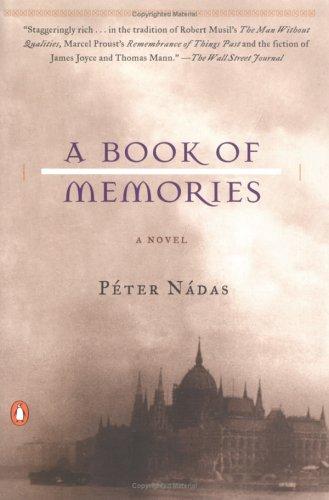
A Book of Memories
Péter Nádas · b. 1942 · Hungary
Originally Emlékiratok Könyve (Hungarian)
Why it matters
Three narrators interweave across late-Communist Budapest, 1900s Berlin, and ancient Rome in an architecture of memory, desire, and surveillance. Over a decade in the writing, and Hungary's great postwar prose monument.
At a glance
Three interleaved narrators, sentence-long paragraphs, and shifting timeframes across a huge novel.
Deep dive
Three first-person strands, a Stalinist Budapest childhood, a Stasi-watched Berlin love triangle, and a novel-within-the-novel set at the fin-de-siècle, share one pronoun and refuse to say clearly which 'I' is speaking.
Written for readers who have finished the book. No plot recap, and nothing here is safe to read first.
Themes & symbolism
Nádas gives the unnamed narrator three separate lives to narrate in the same first person: his own adult years in East Berlin, caught in a shifting, often homoerotic triangle with a woman named Thea and a man named Melchior while the Stasi's surveillance apparatus quietly presses in on all three; his childhood in Stalinist Budapest in the 1950s, dominated by his mother's death and an intense, formative attachment to another boy; and a novel he is writing inside the novel, narrated by a fin-de-siècle aesthete modeled loosely on the world of Thomas Mann, obsessive about beauty and decline in turn-of-the-century Europe. Nádas moves between the three with no formal markers to announce the switch, so that memory, invention, and lived experience are made to share the identical grammatical position, indistinguishable on the page.
The effect is not confusion for its own sake but an argument about what memory actually does: it doesn't recall a life so much as compose one, borrowing the tools of fiction, projection, foreshadowing, retrospective meaning, whether or not the rememberer notices the borrowing. The East German surveillance state, always present at the edges of the Berlin sections, turns out to be a second version of the same idea. A state that reads its citizens' letters and reconstructs their private lives from fragments is doing, officially and with menace, what the narrator is doing to himself throughout the whole book: building a self out of selective, retrospective assembly.
Susan Sontag's Verdict
Susan Sontag championed the English translation on its 1997 American publication, calling it the greatest novel written in her lifetime and comparing its ambition directly to Proust and Mann, a blurb that did more than any review to get Nádas read outside Hungary. The claim was extravagant even by blurb standards, but it named accurately what the book is reaching for: a total, layered reconstruction of consciousness across an entire century, built with the patience and the sentence-level density that both of those earlier writers demanded of their readers.
A Decade Writing Toward One Book
Nádas spent more than a decade composing A Book of Memories under a Hungarian regime still monitoring its writers, working largely without confidence the book would ever be publishable in the form he wanted; it appeared in 1986, near the end of state socialism in Hungary, and its frankness about male desire was itself a quiet defiance of what Communist-era Hungarian publishing had tolerated until then. The novel's difficulty is not incidental to that history. A book this resistant to being summarized or excerpted was also, for its era, much harder for a censor to usefully object to.