
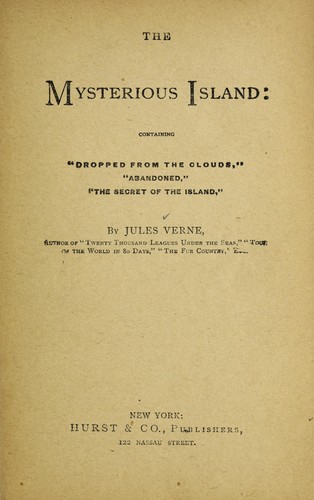
The Mysterious Island
Jules Verne · 1828–1905 · France
Originally L'Île mystérieuse (French)
Why it matters
Five Civil War prisoners escape by balloon and crash onto an empty Pacific island, building a civilization from nothing with Yankee ingenuity and the secret help of a hidden benefactor: Verne's robinsonade crossed with hard-science survivalism.
At a glance
Long and detail-heavy, cataloguing survival technique at Verne's most exhaustive.
Deep dive
Why reading this as a direct sequel to Twenty Thousand Leagues changes what its mysterious island benefactor actually is, and what five escaped prisoners of war build once they have him.
Written for readers who have finished the book. No plot recap, and nothing here is safe to read first.
Themes & symbolism
Five Union prisoners escape a Confederate siege by hijacking a reconnaissance balloon during a storm and crash-land on an uncharted Pacific island, and Verne spends most of the novel less on adventure than on an extended demonstration of applied engineering: Cyrus Smith, an engineer by training, leads the group through smelting metal, manufacturing explosives, building a telegraph line, and eventually constructing a functioning colony essentially from raw materials and first principles, treating the island as a controlled experiment in whether nineteenth-century scientific knowledge alone, without any inherited infrastructure, can rebuild civilization from nothing. Verne's real interest here is competence as a genre unto itself, a Robinsonade rewritten so that survival depends on organized expertise rather than luck or providence.
A mysterious, unseen benefactor keeps intervening at exactly the moments the colonists' survival is in doubt, leaving supplies, rescuing Cyrus Smith from drowning, guiding a dog to a wounded man, and the slow reveal of who this figure actually is only lands with its full weight if the reader already knows Twenty Thousand Leagues Under the Sea: the benefactor is Captain Nemo, whose earlier novel ended by refusing to say whether he had survived the Norwegian maelstrom at all. This novel answers that suspended question directly, and answering it changes the character retroactively, since Nemo is finally named here as Prince Dakkar, an Indian nobleman who lost his family and country to British colonial suppression of the Sepoy uprising, which recasts his earlier vengeance against a warship not as unaccountable menace but as a specific, comprehensible act of anticolonial reprisal that the first novel had only gestured at.
Nemo's dying wish, once the colonists finally discover him hidden in an underwater grotto with his failing Nautilus, is to be buried at sea inside the vessel that had been both his prison and his kingdom, and Verne stages the moment as a deliberate closing of the earlier novel's ambiguity: the man who once withdrew entirely from human judgment now asks, at the very end, to be judged kindly by the ordinary, decent men he has spent the whole novel secretly protecting, a settlement Twenty Thousand Leagues had explicitly refused to grant him.
What Being a Sequel Does to Nemo
Twenty Thousand Leagues left Nemo's fate and motives deliberately unresolved, an anonymous genius whose grief and vengeance Aronnax could only speculate about from the outside; this novel answers nearly every open question that earlier book declined to close, a name, a nationality, a specific colonial injury, and a peaceful death witnessed and mourned by people he chose to help rather than merely observe. Reading the two books as one continuous story rather than separate adventures means watching Verne revise his own most enigmatic creation into someone finally, fully knowable, trading mystery for a settled biography in a way the first novel's ending had gone out of its way to avoid.
The last seal: what actually happens, and why it lands the way it does.
The ending, explained
A volcanic eruption destroys the island entirely just as Nemo has died and been given his sea burial inside the Nautilus, and the colonists escape the collapsing land in a small boat only to be rescued, in the novel's final coincidence, by a ship chartered specifically by Lord Glenarvan's search efforts from In Search of the Castaways, tying Verne's separate adventure series together at the last possible moment. Reunited on American soil, the colonists use the fortune Nemo secretly left them to found a new settlement they name Lincoln Island in memory of the one they lost, closing the novel on continuity rather than rupture, applied engineering and inherited wealth from a dead anticolonial rebel combining to let ordinary competence simply start over.
Where to go next
 Jules Verne · 1864Journey to the Center of the EarthLvl 3Fast paced
 Jules Verne · 1865From the Earth to the MoonLvl 3Medium pace
 Jules Verne · 1868In Search of the CastawaysLvl 3Fast paced
 Jules Verne · 1870Twenty Thousand Leagues Under the SeaLvl 3Medium pace
 Jules Verne · 1873Around the World in Eighty DaysLvl 2Fast paced
 Raymond Queneau · 1959Zazie in the MetroLvl 5Fast paced