
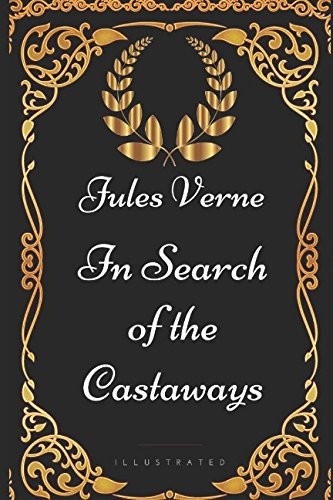
In Search of the Castaways
Jules Verne · 1828–1905 · France
Originally Les Enfants du capitaine Grant (French)
Why it matters
A rescue expedition follows a single line of latitude clear around the globe, through Patagonia, Australia, and New Zealand, chasing three words legible in a shipwrecked bottle: Verne's globe-girdling search-and-rescue epic, propelled by nothing but a scrap of paper.
At a glance
Long and episodic, though narrated in plain, expository adventure prose.
Deep dive
Why a scrap of paper that three men can barely agree how to translate sends an entire expedition circling the globe along a single line of latitude, trusting a document none of them can actually read in full.
Written for readers who have finished the book. No plot recap, and nothing here is safe to read first.
Themes & symbolism
The novel's whole plot is set in motion by a water-damaged message recovered from a shark's stomach, its surviving fragments scattered across English, French, and German in a way that makes even the exact meaning of the coordinates genuinely uncertain, and Verne builds the expedition's entire logic around interpreting a text that refuses to resolve cleanly. Lord Glenarvan and his search party settle on the 37th parallel south as the one fixed point the fragments agree on, then commit to sailing the entire circumference of the globe along that single line, through Patagonia, across Australia, and finally to New Zealand, treating incomplete information as something perseverance can eventually out-argue rather than a reason to turn back.
Jacques Paganel, the endearingly brilliant and endearingly careless geographer who boards the wrong ship entirely by accident at the novel's start, gives the decoding theme its comic double: where Glenarvan's party treats the message with patient, methodical rigor, Paganel keeps making exactly the kind of confident, well-informed mistakes that show how easily expertise curdles into overconfidence, most famously insisting for chapters that the party has landed in Chile when they are unmistakably in Patagonia. Verne uses him to argue, gently, that a document this fragmentary rewards humility over cleverness, and that the search's real danger isn't ignorance so much as the wrong kind of confidence.
Ayrton, the ship's quartermaster who turns out to be a mutineer with his own designs on Glenarvan's yacht, threads through the Australian leg of the journey as proof that the search for Captain Grant is never simply man against geography; Verne keeps folding a human betrayal into the expedition's contest with distance and translation, so that misreading a person turns out to carry the same risk as misreading a water-stained scrap of paper.
A Parallel as a Plot Device
Committing to one fixed latitude rather than a single destination lets Verne stage three entirely different continents' worth of adventure, a Patagonian earthquake and condor attack, an Australian bushfire and Ayrton's mutiny, a Maori uprising in New Zealand, inside a single unbroken search, and the device does real structural work beyond variety: every failure to find Captain Grant along the parallel reads as evidence the document itself might be flawed rather than the searchers, keeping the mystery of the message's true meaning alive across the entire length of the novel.
The last seal: what actually happens, and why it lands the way it does.
The ending, explained
The party finally locates Captain Grant not through better decoding but through simple persistence, on a small island near New Zealand where he has survived alone for years, and the message's ambiguity turns out to have cost them nothing worse than an unnecessarily long route to a right answer, the coordinates having been correct all along despite every argument over how to read them. Ayrton, exposed as the mutineer he is, is left marooned on the same island his own crimes helped orchestrate, a punishment Glenarvan frames as mercy rather than execution. The reunited party returns Grant and his rescuers home together, Verne closing the loop on a document that never stopped being incomplete by proving that the searchers' faith in it, however contested at every stage, was ultimately better placed than their doubts.
Where to go next
 Jules Verne · 1864Journey to the Center of the EarthLvl 3Fast paced
 Jules Verne · 1865From the Earth to the MoonLvl 3Medium pace
 Jules Verne · 1870Twenty Thousand Leagues Under the SeaLvl 3Medium pace
 Jules Verne · 1873Around the World in Eighty DaysLvl 2Fast paced
 Jules Verne · 1874The Mysterious IslandLvl 4Fast paced
 Raymond Queneau · 1959Zazie in the MetroLvl 5Fast paced