
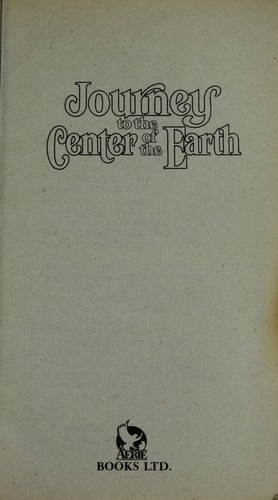
Journey to the Center of the Earth
Jules Verne · 1828–1905 · France
Originally Voyage au centre de la Terre (French)
Why it matters
A professor, his nephew, and their guide descend through an Icelandic volcano into a subterranean world of prehistoric creatures and ancient seas. Verne's scientific romance turned geology itself into an adventure story.
At a glance
Plain, expository adventure narration aimed at a popular audience.
Deep dive
Why the real hero of Verne's descent is a runic cipher, and what happens once the professor who cracked it starts trusting the ground itself to keep telling him the truth.
Written for readers who have finished the book. No plot recap, and nothing here is safe to read first.
Themes & symbolism
Professor Lidenbrock is a philologist first and a geologist only by extension, and Verne makes the whole expedition begin as an act of reading rather than exploration: the cryptic runic message tucked inside a medieval Icelandic saga, decoded only once Lidenbrock's nephew Axel stumbles on the trick of reversing it, sends them to Iceland's Snæfellsjökull crater in the first place. Verne keeps that decoding logic running the entire way down, since every stratum the two men pass through is treated as another text to interpret, fossil beds read like sentences, an underground ocean's currents read for what they imply about a route back to the surface, so the earth's interior becomes less a place than an increasingly ancient library nobody has opened in millions of years.
Axel's terror and exhaustion, constantly overridden by his uncle's monomaniacal scientific hunger, give the novel its real human tension: Lidenbrock treats every mortal danger, thirst, a lost path, a subterranean storm, as data first and threat second, and Verne lets Axel's growing willingness to keep descending anyway become its own quiet coming-of-age story, a nephew learning to trust a method he initially found reckless. The living Ichthyosaurus-and-Plesiosaurus battle they witness on the underground sea, along with the towering mastodon herd and the human-like giant glimpsed tending them, push the geological reading past mere rock into deep time made suddenly, terrifyingly present tense, prehistory not studied from bones but encountered walking around.
A Discovery Nobody Back Home Has to Believe
Verne ends the expedition on a joke about evidence rather than a triumphant homecoming: the three travelers are launched back to the surface by a volcanic eruption inside Stromboli, in Italy, thousands of miles from where they entered, arriving with no photographs, no specimens beyond a few notes, and a story so implausible that Lidenbrock's own scientific colleagues receive it with polite, unresolved skepticism. That anticlimax fits the novel's whole method, since a book built on decoding texts is honest enough to end by admitting that the travelers' own account is now just one more unverifiable document waiting for someone else to trust or dismiss.
Where to go next
 Jules Verne · 1865From the Earth to the MoonLvl 3Medium pace
 Jules Verne · 1868In Search of the CastawaysLvl 3Fast paced
 Jules Verne · 1870Twenty Thousand Leagues Under the SeaLvl 3Medium pace
 Jules Verne · 1873Around the World in Eighty DaysLvl 2Fast paced
 Jules Verne · 1874The Mysterious IslandLvl 4Fast paced
 Raymond Queneau · 1959Zazie in the MetroLvl 5Fast paced