
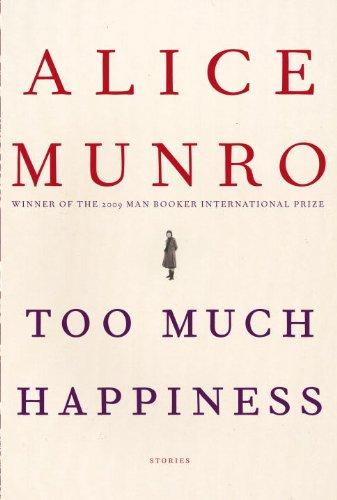
Too Much Happiness
Alice Munro · 1931–2024 · Canada
Why it matters
Domestic violence and its long aftermath recur across ten stories, from a husband's shocking act of filicide to a woman revisiting her long-ago assailant, building to a title novella about the brilliant, thwarted mathematician Sofya Kovalevskaya. Munro's darkest, most historically expansive collection.
At a glance
Darker material and a biographical title novella push beyond Munro's usual small-town compression.
Deep dive
Ten stories move from small-town Ontario kitchens to nineteenth-century Russian mathematics, held together by how suddenly ordinary lives turn violent.
Written for readers who have finished the book. No plot recap, and nothing here is safe to read first.
Themes & symbolism
In Dimensions, the collection's opening story, Doree rides three buses every week to visit her husband Lloyd in the psychiatric facility where he is held for killing their three children, and Munro spends the story less on the crime itself than on the strange, unwanted intimacy Doree still feels toward the man who destroyed her family, an intimacy she can't fully explain even to herself. Free Radicals pushes the collection's violence into a single afternoon: an elderly widow, alone in her house, talks her way past a man who has just killed his own family, matching his horror with an invented murder confession of her own to keep him from adding her to the count.
Too Much Happiness, the sixty-page title novella that closes the book, dramatizes the real life of Sofya Kovalevskaya, the first woman in modern Europe to earn a doctorate in mathematics, tracking her professional exile from country to country in search of a professorship no institution would grant a woman outright, her unstable marriage to the political theorist Maxim Kovalevsky, and her death from pneumonia on a lecture trip in 1891, redirecting Munro's usual scope, contemporary and rural Ontario, into biography and nineteenth-century Europe without losing the collection's central interest in how much a woman is allowed to want out of her own life.
Doree's Weekly Visits to the Man Who Killed Her Children
The bus rides themselves, three transfers each way to a facility Doree can barely afford to reach, become their own kind of penance, and Munro lets a near-fatal highway accident on one such trip briefly interrupt even that ritual, forcing Doree to notice how entirely her life has narrowed down to this one, unresolved obligation.
Sofya Kovalevskaya's Doctorate Against the Rules of Her Century
Kovalevskaya studies privately under Karl Weierstrass because German universities won't admit women to lectures, and enters a marriage of convenience with a paleontologist largely to secure the legal freedom to travel and study at all, a bureaucratic workaround Munro treats with the same clear-eyed attention she gives the collection's domestic violence, another system built to make a woman's ambition cost more than a man's ever would.
Where to go next
 Alice Munro · 1971Lives of Girls and WomenLvl 5Medium pace
 Alice Munro · 1978Who Do You Think You Are?Lvl 5Medium pace
 Alice Munro · 2001Hateship, Friendship, Courtship, Loveship, MarriageLvl 5Medium pace
 Alice Munro · 2004RunawayLvl 5Medium pace
 Alice Munro · 2012Dear LifeLvl 5Medium pace
 Elizabeth Strout · 2008Olive KitteridgeLvl 4Medium pace