
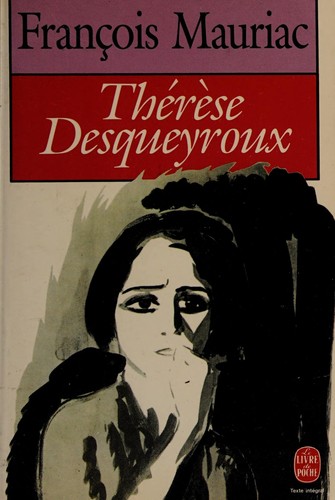
Thérèse Desqueyroux
François Mauriac · 1885–1970 · France
Originally Thérèse Desqueyroux (French)
Why it matters
Acquitted of poisoning her husband, a provincial bourgeois wife must return to the suffocating family and social world that drove her to it. Mauriac's compact masterpiece of guilt, entrapment, and the search for grace.
At a glance
Dense, compressed interiority packed into a very short novel.
Deep dive
A provincial wife walks free from the courthouse that could have convicted her of poisoning her husband, and Mauriac spends the train ride home making sure the acquittal feels like no kind of victory at all.
Written for readers who have finished the book. No plot recap, and nothing here is safe to read first.
Themes & symbolism
Mauriac opens on Thérèse's acquittal already secured, which strips the novel of the one question a lesser treatment of this material would have built suspense around, and replaces it with a harder one: not whether she'll be caught, but why she did it at all, a question Thérèse spends the train journey home turning over without ever quite landing on an answer that satisfies her. She isn't in love with anyone else, doesn't hate Bernard with any dramatic intensity, isn't chasing money she doesn't already have; what she can identify, circling closer across the journey, is something closer to suffocation, a life of pine forests, family obligation, and provincial routine closing over her so completely that poisoning her husband's medicine reads, in her own retrospective account, almost as a bid to feel something at all.
The Landes pine forest that surrounds the family's estate functions as more than scenery throughout: Mauriac describes it as a wall as much as a woodland, planted in orderly rows for timber revenue, offering no clearing, no real horizon, a landscape as economically rational and as spiritually airless as the marriage it encloses. As a Catholic novelist preoccupied across his work with grace reaching even the most compromised souls, Mauriac refuses to make Thérèse either a monster or a martyr; she remains legible mainly as a woman starved by a world that gave her no vocabulary for what she actually wanted, which is exactly what keeps her, and the book, resistant to easy judgment.
A Verdict the Family Passes Instead of the Court
Bernard's public testimony saving Thérèse from conviction has nothing to do with belief in her innocence and everything to do with protecting the family name from scandal, and Mauriac makes that motive explicit almost immediately: the real trial the novel is interested in isn't the one that already ended, it's the private sentence Bernard hands down once they're home, confining Thérèse to near-total isolation within her own house as the price of his silence. That domestic verdict, delivered without a judge or a jury, is presented as more binding and more punishing than anything the actual legal system was prepared to impose.
The last seal: what actually happens, and why it lands the way it does.
The ending, explained
Bernard eventually relents, not out of forgiveness but out of a kind of exhausted pragmatism: keeping Thérèse permanently confined has become more trouble than it's worth to the family's reputation, so he agrees to let her live apart in Paris, and the novel closes with the two of them at a café terrace, Bernard asking her, one last time and with no real hope of an answer that will satisfy him, why she did it. Thérèse tries to explain and can't quite manage it even now, and the freedom Mauriac grants her at the end reads less as liberation than as release into a different kind of solitude, anonymous rather than confined, a woman finally alone with a self she still can't fully account for.
Where to go next
 François Mauriac · 1932The Knot of VipersLvl 5Medium pace
 Gustave Flaubert · 1857Madame BovaryLvl 5Slow burn
 Guy de Maupassant · 1885Bel-AmiLvl 4Medium pace
 Émile Zola · 1885GerminalLvl 5Medium pace
 Marcel Proust · 1913Swann's WayLvl 8Slow burn
 Joris-Karl Huysmans · 1884Against Nature (À rebours)Lvl 7Slow burn