
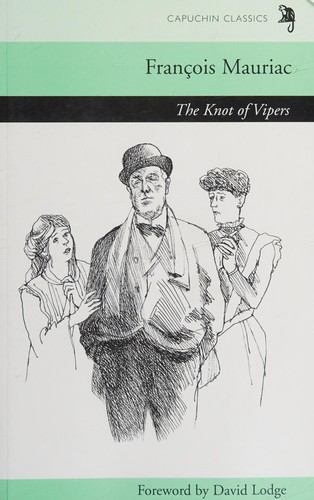
The Knot of Vipers
François Mauriac · 1885–1970 · France
Originally Le Nœud de vipères (French)
Why it matters
A dying, embittered patriarch writes a confessional letter itemizing decades of grievance against the family he's spent his life despising. Mauriac's most concentrated study of provincial Catholic guilt and buried love.
At a glance
A single first-person confessional letter, dense with moral self-scrutiny.
Deep dive
A dying, embittered man writes his wife a letter meant to itemize every grievance of their marriage, and Mauriac lets it turn, almost without the writer noticing, into something else.
Written for readers who have finished the book. No plot recap, and nothing here is safe to read first.
Themes & symbolism
Louis's whole life curdles around one overheard sentence, his wife Isa confessing to her sister, early in their marriage, that she never loved him and only married for security, still mourning a dead fiancé named Rodolphe she'd been forced to give up. Mauriac treats that single moment of accidental honesty as the wound Louis has spent decades avenging, through calculated meanness, financial threats against his own children, and a hoarded fortune he plans to keep from everyone in the family who might otherwise have loved him for it rather than for his money. Louis narrates his own transformation from a hopeful young husband into this figure with a lawyer's precision, dating the exact conversation and the exact sentence, as though the marriage's whole later history were simply a long, methodical brief written in response to it.
The title's image, a heart Louis compares to a knot of vipers, coiled and inseparable, argues that sustained hatred is its own kind of intimacy, closer in its daily attention and obsessive detail to love than indifference could ever be. Mauriac isn't redeeming the metaphor so much as insisting on its logic: you cannot despise someone this thoroughly, for this long, tracking every slight and rehearsing every grievance, without it becoming the organizing relationship of your entire life.
Luc's War, and the Crack It Leaves in Louis
Luc, a young relation whose plain, unreflective goodness Louis has spent the book quietly noting and half dismissing as simple-mindedness, dies in the First World War, and his death does what decades of family argument couldn't: it reopens a question of faith Louis has spent his adult life closing off with legal precision and cold logic, letting something like grace back in through a grief that has nothing calculating about it at all.
A Confession Meant as a Weapon
Louis writes his long letter to Isa intending it as a posthumous accusation, a lawyer's brief against a marriage he believes wronged him from the start, but the writing itself gradually turns the document into something closer to a conversion narrative than a verdict, the accusing voice slowly giving way, page by page, to something more like confession. The family, reading it after his death, catches only the bitterness on the page and misses the turn entirely, arguing over what he meant rather than what he became.
The last seal: what actually happens, and why it lands the way it does.
The ending, explained
Before his death Louis quietly rewrites his will, providing generously for the family he has spent the whole book vowing to disinherit, a decision made privately and explained to no one, not even Isa. His children discover both the letter and the new will only after he is gone, and read the will as a final, inexplicable eccentricity rather than evidence of the reconciliation the letter, read properly, actually documents throughout its later pages. Only the reader who has followed the whole confession from its bitter opening can see that Louis died a considerably softer man than the one who began writing it.
Where to go next
 François Mauriac · 1927Thérèse DesqueyrouxLvl 5Slow burn
 Gustave Flaubert · 1857Madame BovaryLvl 5Slow burn
 Guy de Maupassant · 1885Bel-AmiLvl 4Medium pace
 Émile Zola · 1885GerminalLvl 5Medium pace
 Marcel Proust · 1913Swann's WayLvl 8Slow burn
 Joris-Karl Huysmans · 1884Against Nature (À rebours)Lvl 7Slow burn