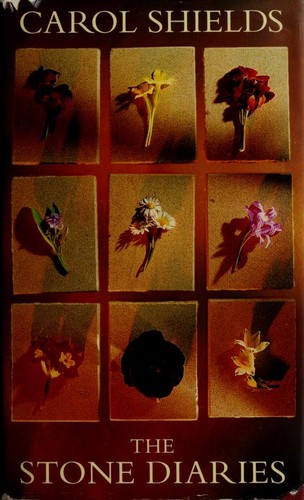
The Stone Diaries
Carol Shields · 1935–2003 · Canada / United States
Why it matters
An ordinary Canadian woman's entire life (birth, marriages, motherhood, old age) is narrated as though it were an epic, complete with invented photographs and obituaries. Shields's Pulitzer winner insists a woman's unremarkable life deserves fiction's full architecture.
At a glance
A fragmented, documentary structure narrates one life from odd, oblique angles.
Deep dive
A fake documentary of an invented life, and why its narrator can't be trusted to know her own story.
Written for readers who have finished the book. No plot recap, and nothing here is safe to read first.
Themes & symbolism
Shields' formal trick — mixing first- and third-person, inventing photographs, recipes, letters, an obituary — isn't decoration; it's the novel's whole argument. Daisy Goodwill Flett's life is narrated the way an important life would be narrated (with documentary apparatus, with the presumption that every detail matters), and the gap between that apparatus and Daisy's actual, unremarkable-seeming biography is where the book does its work. The joke and the tragedy sit together: Daisy is present at her own birth (her mother, Mercy, dying in childbirth without having known she was pregnant, a detail Shields plays with total matter-of-factness) and largely absent from her own account of her life thereafter, ceding the narration to other people's versions of her whenever her own voice falters. That instability is deliberate — other characters' testimony about Daisy routinely contradicts her own, and Shields uses the discrepancy to insist that no life, examined closely enough, resolves into a single coherent story, least of all a woman's, which is exactly the kind of life official history has always been willing to let go undocumented.
Daisy's gardening column, written under her own name late in life, is the book's one moment of a woman claiming public authorship over anything — and Shields makes sure it's taken from her by younger colleagues almost as soon as she's found it, a small, exact cruelty that mirrors the larger one: even the novel itself keeps almost losing Daisy to other people's narration of her.
Harold Hoad's honeymoon fall
Daisy's first husband, Harold, dies falling from a hotel window on their honeymoon before the marriage is even consummated — an event so absurd and abrupt that it functions almost as a formal joke about plot itself, the kind of incident a conventional novel would build toward and this one simply reports and moves past. It sets the pattern for how Shields treats catastrophe throughout: not as climax but as one more entry in an inventory, which is precisely how Daisy herself seems to experience her own life, at one remove, cataloguing rather than inhabiting it.
The last seal: what actually happens, and why it lands the way it does.
The ending, explained
The novel closes on Daisy's decline and death exactly as it opened on her birth: through borrowed documentary forms rather than direct interiority — a mock obituary, a final inventory-like list of who and what survives her. There's no last scene of clarity where Daisy's 'true self' finally emerges from under all the competing testimony; Shields pointedly withholds it. The book ends on the same note of documentary uncertainty it started with, because that uncertainty was never a flaw in the record — it was the argument. A life this ordinary is exactly as vast and as finally unknowable as any life history bothers to canonize, and the diaries stay stone: solid, official-looking, and ultimately mute about what they contain.