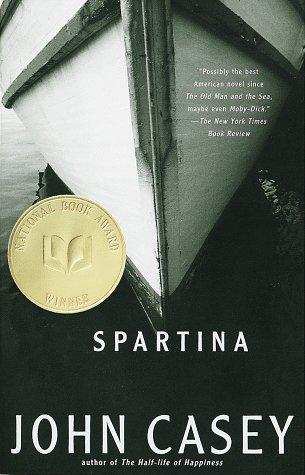
Spartina
John Casey · b. 1939 · United States
Why it matters
A proud, debt-ridden Rhode Island fisherman builds his own boat by hand while a hurricane, an affair, and his own stubbornness threaten to sink him. Casey's National Book Award winner is New England working life rendered with a sailor's exact, loving knowledge.
At a glance
Dense nautical detail rewards patience but never obscures a clear, driving plot.
Deep dive
A half-finished fishing boat and an oncoming hurricane force a stubborn waterman to decide, in a single afternoon, whether the compromises he made to build her were worth it.
Written for readers who have finished the book. No plot recap, and nothing here is safe to read first.
Themes & symbolism
Dick Pierce's slow, self-funded construction of his boat is an emblem of working-class self-reliance under siege from the wealthy summer people whose land rules and casual condescension threaten his entire livelihood, and the marsh grass the boat is named for gives the novel its explicit metaphor: spartina bends flat under storm surge and floods, then springs back once the water recedes, rather than resisting and snapping. That's the character trait the novel keeps testing in Dick — survival through stubborn adaptation, not through confrontation, even when confrontation is exactly what his pride wants.
His affair with May Muchmore complicates the class-resentment plot instead of simply resolving it into betrayal: she's an outsider who has come to take the marsh's ecology and history seriously in a way the club members never do, so the affair reads less as a straightforward wrong against his wife Elsie than as Dick briefly finding someone who shares his actual relationship to the physical place, rather than treating it as scenery or investment. The illegitimate child that results forces a reckoning the novel handles with unusual pragmatism — families here absorb complication instead of shattering over it, which is its own quiet argument about what working-class endurance actually looks like up close.
The Hurricane as Trial by Water
The storm sequence is the novel's real climax, and Casey builds it as a direct test of whether the half-legal, half-desperate compromises Dick made to fund and finish the boat — running drugs among them — were worth what they cost him. Taking Spartina out into open water rather than risk her at the dock is less bravado than the only economics available to an uninsured man with no other capital: if the boat goes, everything goes, so riding out the storm becomes simultaneously the most reckless and the most rational choice open to him.
A Working Waterman's Language
Casey renders Dick's interior life in a dense, technically fluent register — boatbuilding terms, tidal knowledge, the granular vocabulary of a trade — that never condescends to its subject the way outsider fiction about working-class characters often does. The prose assumes the reader will keep up with real gear and real water the way it assumes the summer people never will, which is itself part of the novel's argument about who actually possesses this coastline and who merely visits and legislates over it.
The last seal: what actually happens, and why it lands the way it does.
The ending, explained
Dick and the battered Spartina survive the hurricane intact, and Elsie's eventual decision to accept both her husband and the consequences of his affair — the child May has borne him — into some working arrangement resists tidy resolution in favor of the same principle the marsh grass embodies throughout: bend, absorb, don't break, and don't expect the ledger to ever come out perfectly even. Nothing here is forgiven so much as accommodated, which the novel presents as its own hard-won, unglamorous form of survival.