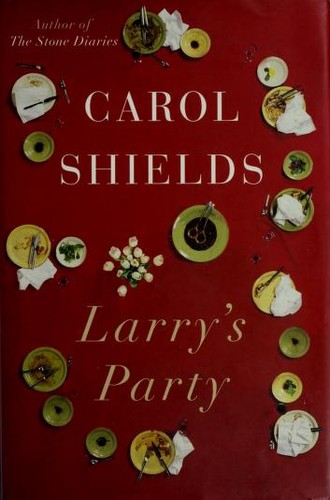
Larry's Party
Carol Shields · 1935–2003 · Canada / United States
Why it matters
An ordinary Winnipeg florist discovers a passion for building garden hedge mazes after his honeymoon at Hampton Court, and the novel leaps forward in years to track his marriages and inner life. Shields again insists an unremarkable life deserves fiction's full attention.
At a glance
Warm, accessible prose moves in clear multi-year leaps rather than a dense structure.
Deep dive
Carol Shields tracks one unremarkable Winnipeg florist across two decades and fifteen snapshots of his life, and lets his sideline obsession with building ornamental garden mazes become the shape the novel offers for what a life actually adds up to.
Written for readers who have finished the book. No plot recap, and nothing here is safe to read first.
Themes & symbolism
Larry Weller, born into a working-class Winnipeg family in 1950, drifts into floral design and then, after a chance visit to the maze at Hampton Court during his first honeymoon, into a specialized career designing ornamental hedge mazes for wealthy clients. Shields structures the novel as fifteen discrete chapters, each set two or three years after the last, spanning 1977 to 1997, each focused tightly on a single facet of Larry's life, a marriage, a divorce, his estranged relationship with his son Ryan, rather than building toward any conventional dramatic arc, a structural choice that mimics the mazes themselves: movement without a straight line, plenty of doubling back, a shape only visible once you've walked the whole thing.
The maze functions as the novel's controlling metaphor, but Shields resists letting it resolve into anything too tidy: Larry himself never fully articulates what draws him to designing structures whose entire purpose is confusing people on purpose, and Shields treats that inarticulacy as accurate to how most people actually experience the shape of their own lives, felt rather than understood, assembled retroactively rather than planned. Larry's two divorces, his health scares, his slow drift toward genuine expertise in a strange, specific craft, accumulate less like a plot than like the paths of a maze finally viewed from above.
An Ordinary Man as Literary Subject
Shields, better known for the more overtly literary Stone Diaries, deliberately picks an unglamorous protagonist, a man with no exceptional insight, no dramatic ambition beyond craftsmanship, and builds an entire novel's worth of interiority around him anyway. The choice is itself an argument: that a life doesn't need to be exceptional to reward this much narrative attention, only closely enough observed.
Class Travel Without a Rags-to-Riches Arc
Larry's rise from a working-class Winnipeg upbringing to a clientele of wealthy garden owners could easily supply a conventional success story, but Shields keeps the class dimension quietly present rather than triumphant: Larry never stops noticing the gap between his own origins and the money now paying for his work, and Shields treats that low-grade, persistent awareness as more honest than either shame or pride would be.
The last seal: what actually happens, and why it lands the way it does.
The ending, explained
By the novel's final chapter, Larry has built a career, weathered two failed marriages, and reconnected, tentatively, with his son, and Shields resolves the accumulated twenty years not with a single dramatic event but with a party, hosted by Larry and a new partner, to which both of his ex-wives happen to be invited and both attend. The gathering doesn't stage confrontation or reconciliation so much as simple coexistence, everyone Larry has loved and disappointed occupying the same room without incident, which is the modest, hard-won achievement the novel has been building toward all along. Shields ends on Larry surveying the party the way he might survey a completed maze from above, its shape only fully visible now that every path has actually been walked.