
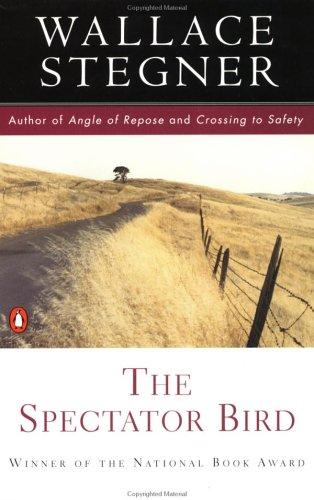
The Spectator Bird
Wallace Stegner · 1909–1993 · United States
Why it matters
A retired literary agent, prompted by an old friend's postcard, digs out his journal from a decades-old trip to his mother's native Denmark and confronts a dark secret he had buried along with his own restlessness. Stegner's National Book Award winner is late-life reckoning at its most controlled.
At a glance
A frame narrative alternating present-day scenes with old journal entries reads smoothly despite the layered structure.
Deep dive
A postcard from a Danish countess he hasn't spoken to in twenty years sends a retired literary agent back into a diary he kept during the one trip of his life he's never told his wife the whole truth about.
Written for readers who have finished the book. No plot recap, and nothing here is safe to read first.
Themes & symbolism
Joe Allston, seventy, retired, and characteristically prickly about most things including his own retirement, receives an unexpected postcard from Astrid Wredel-Krarup, a Danish countess he and his wife Ruth stayed with two decades earlier, and the arrival forces him to finally show Ruth the diary he kept during that trip, taken in the aftermath of their only child Curtis's death. Stegner structures the novel by alternating between Joe's present-day irritability, a man who has built an entire identity around being a spectator to his own life rather than a participant in it, and the diary itself, read aloud to Ruth chapter by chapter, which slowly reveals exactly how far Joe let himself become involved with Astrid decades before.
Astrid's own household in Copenhagen, entangled with her estranged husband's Nazi collaboration and her brother Eigil's inherited eugenics research, gives Stegner a second, darker case study in inherited guilt to set beside Joe's own quieter failures, and the parallel sharpens the novel's real question: whether a marriage, or a life, can survive full disclosure of what its most guarded participant actually did and felt, or whether some self-protective omissions are what intimacy is actually built from.
The Diary as a Marriage's Cross-Examination
Having Ruth read Joe's twenty-year-old diary aloud, in his presence, turns the novel's central device into something closer to a trial than a memoir: every paragraph forces Joe to relive and re-narrate his own past feelings in real time, under his wife's direct scrutiny, a structural choice that makes the reading itself, rather than the events it describes, the novel's actual dramatic present.
Joe's Grief for Curtis Beneath the Romance
The Copenhagen trip that produced the diary was itself an act of flight from Curtis's death, a drowning while surfing that Joe has never been able to settle in his own mind as accident or something more deliberate, and Stegner keeps that older, unresolved grief humming underneath the Astrid material throughout: Joe's attraction to a woman whose own life is defined by loss reads, in retrospect, as much a way of processing his son's death as it is a betrayal of his marriage.
The last seal: what actually happens, and why it lands the way it does.
The ending, explained
The diary eventually confirms what Ruth had suspected without asking directly: Joe did fall for Astrid in Copenhagen, went so far as to ask her to leave Denmark and come live with him and Ruth in America, and the two shared a single kiss before Astrid, citing obligations to her brother and her fractured family, declined. Confessing this now, decades later, costs Joe less than the years of silence that preceded it, and Stegner lets Ruth's response be neither forgiveness nor punishment but something more durable, an acknowledgment that a long marriage survives less by avoiding every temptation than by eventually being able to name them out loud. The novel closes on the Allstons still together, older, no longer performing a completeness neither of them ever quite had, an unglamorous, durable form of intimacy that Stegner treats as its own real achievement.
Where to go next
 Wallace Stegner · 1971Angle of ReposeLvl 6Medium pace
 William Maxwell · 1979So Long, See You TomorrowLvl 5Slow burn
 Wright Morris · 1980Plains Song: For Female VoicesLvl 5Slow burn
 Peter Taylor · 1986A Summons to MemphisLvl 5Slow burn
 Carol Shields · 1993The Stone DiariesLvl 5Medium pace
 Pearl S. Buck · 1931The Good EarthLvl 3Medium pace