
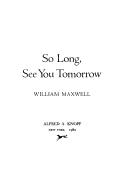
So Long, See You Tomorrow
William Maxwell · 1908–2000 · United States
Why it matters
An old man reconstructs an Illinois farm murder from his own boyhood, and the friendship he abandoned in its wake, in a spare meditation on guilt and memory's failures. Maxwell's late masterpiece is American fiction's quietest tragedy.
At a glance
A narrator's uncertain memory circles the same trauma from shifting angles.
Deep dive
A fifty-year-old murder gets solved by a novel that admits, on nearly every page, it's inventing half of what it tells you.
Written for readers who have finished the book. No plot recap, and nothing here is safe to read first.
Themes & symbolism
The murder that anchors the book — Clarence Smith killing his neighbor Lloyd Wilson after Lloyd's affair with Clarence's wife, Fern — is public record the narrator can reconstruct with some confidence. What he can't reconstruct is Cletus, the murderer's son and his own childhood friend, whose interior life during and after the killing the narrator openly admits he is inventing rather than recalling. That admission is the novel's real subject: this isn't a mystery to be solved so much as an act of imaginative restitution for a specific failure — years after the murder, the narrator passed Cletus in a school hallway and looked away, too embarrassed by the scandal to acknowledge him, and the entire book is offered as a belated, admittedly inadequate attempt to make amends to someone he can no longer actually reach.
The Smith family dog, Trixie, gets her own extended point-of-view section when father and son both abandon her — she howls for pages, the narrator tells us, invoking every dog she's descended from back to some ancestral wolf. It's the novel's rawest expression of grief precisely because it's displaced onto a creature with no language and no self-consciousness to filter it, in a book otherwise obsessed with how imperfectly people manage to say anything true to one another.
The narrator's own household loss — his mother's death in the 1918 influenza epidemic, his father's swift remarriage, the family's own uprooting afterward — runs quietly parallel to Cletus's story rather than sitting apart from it as mere background. Maxwell never states the connection outright, but it's the clearest available explanation for why a grieving, displaced boy would have flinched from another boy's more public, more scandalous family collapse instead of recognizing a kindred loss: his own grief left him with nothing steady enough to offer someone else's.
The Farmhouse in the Museum
Maxwell's narrator recalls, as an adult, wandering into the Museum of Natural History in New York and finding, reconstructed inside a diorama, the actual Lincoln, Illinois farmhouse tied to the murder — plucked from its real setting and displayed, decontextualized, as a specimen of vanished rural life. The moment works as the book's clearest image for what memory and narrative do to lived experience generally: they preserve a thing by removing it from the only context that made it true, which is exactly the operation the novel itself is performing on Cletus.
The last seal: what actually happens, and why it lands the way it does.
The ending, explained
The narrator never finds Cletus in any reliable way, present or remembered — the facts of the murder are recoverable from public record, but Cletus's inner life and any real reckoning between the two boys are not. The book's final pages abandon reportage for an openly invented dream: the narrator pictures "the Cletus of memory" walking, arms outstretched, across the middle of the old Lincoln movie palace at four in the morning, balanced like a wire-walker over nothing at all. It isn't a resolution so much as a confession that resolution was never available — the amends the narrator wanted to make fifty years too late can only happen in a scene he admits, this once, he made up.
Where to go next
 Wright Morris · 1980Plains Song: For Female VoicesLvl 5Slow burn
 Peter Taylor · 1986A Summons to MemphisLvl 5Slow burn
 Carol Shields · 1993The Stone DiariesLvl 5Medium pace
 John Casey · 1989SpartinaLvl 4Medium pace
 Alice McDermott · 1998Charming BillyLvl 5Slow burn
 Jaimy Gordon · 2010Lord of MisruleLvl 6Slow burn