
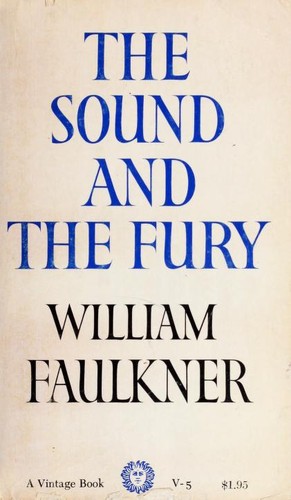
The Sound and the Fury
William Faulkner · 1897–1962 · USA
Why it matters
The Compson family's fall told four times, first through the mind of Benjy, to whom time does not exist. American modernism's boldest leap; Faulkner called it his 'most splendid failure,' and wrote it for love.
At a glance
Four fractured, nonlinear narrators, including a nonverbal mind, defy conventional reading.
Deep dive
Why the same short span of days gets narrated four times before the story is finally allowed to leave the Compsons' heads.
Written for readers who have finished the book. No plot recap, and nothing here is safe to read first.
Themes & symbolism
Each section is a different relationship to time collapsing under the same pressure: Benjy has none, so 1898 and 1928 exist on the same page, triggered by a smell or a word; Quentin has too much, smashing his grandfather's watch and still hearing it tick, because a Harvard education has only given him more precise language for his obsession with stopping the clock on Caddy's honor before it can be lost. Jason lives entirely in a grudging, transactional present — ledgers, telegrams, a stolen inheritance he skims dollar by dollar — which makes him the family's most "functional" member and its most morally bankrupt. The title's source, Macbeth's "tale told by an idiot, full of sound and fury, signifying nothing," is a dare: the novel opens inside that idiot's mind and asks whether meaning can survive being told this way.
Caddy is the hole every section circles and never fills — she narrates nothing, appears only refracted through her brothers' fixations, and her one recorded rebellion (getting pregnant, getting disowned) becomes the pretext for three different kinds of male ruin. Benjy loves her as pure sensory presence (the smell of trees); Quentin's incestuous fantasies about her are really a fantasy of controlling her at all, since actual chastity was never his to guard; Jason simply monetizes her daughter, Miss Quentin, as recompense for the job he blames Caddy for costing him. A family obsessed with honor produces three men who each turn honor into something private, sterile, and finally violent.
Four Narrators, One Absence
Faulkner called the book his most splendid failure because he felt he never got Caddy right and kept starting over — first Benjy's section, then Quentin's, then Jason's, then finally handing the last day to a conventional third-person narrator focused on Dilsey, as if only an outside, communal perspective could finally see the family clearly after three interior ones had failed. That escalating structure is the novel's real argument: subjectivity alone cannot redeem the Compsons, only distance can.
Dilsey's Church and the Compsons' Clock
Dilsey, the Compsons' Black cook and the household's only adult, gets no interior monologue at all — Faulkner grants her instead the dignity of being simply, reliably present, embodied in the sermon she carries Benjy to hear, where the preacher's voice transforms from a small, unremarkable man's into something that seems to fill the church with "de resurrection en de light." Her famous line, "I've seed the first en de last," reads as the closest thing the novel offers to wisdom earned rather than inherited or hoarded.
The last seal: what actually happens, and why it lands the way it does.
The ending, explained
On Easter Sunday, Dilsey takes Benjy to the Black church's service while Jason, discovering that his niece Miss Quentin has run off with a traveling showman and taken the money he'd been embezzling from her (money that was originally Caddy's), tears through town in a futile, rage-blind chase. The novel's final image is smaller and stranger: Luster drives Benjy's carriage the wrong way around the town square, past the Confederate monument, and Benjy screams in inconsolable distress until Jason wrenches the reins back to the familiar route, restoring the exact, meaningless order Benjy needs. It's a bleak closing joke on the whole book — after four narrators and thirty years, all this family can offer anyone is the correct direction around a statue of its own dead cause.
Where to go next
 William Faulkner · 1930As I Lay DyingLvl 9Medium pace
 William Faulkner · 1936Absalom, Absalom!Lvl 10Slow burn
 William Faulkner · 1950Collected Stories of William FaulknerLvl 7Slow burn
 William Faulkner · 1954A FableLvl 9Slow burn
 William Faulkner · 1962The ReiversLvl 4Medium pace
 Cormac McCarthy · 1992All the Pretty HorsesLvl 6Medium pace