
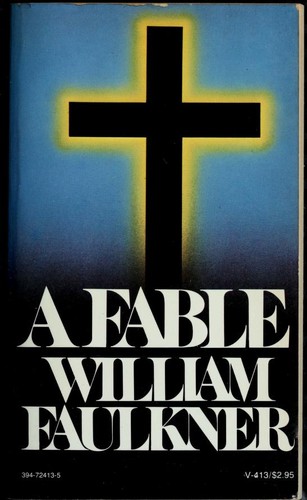
A Fable
William Faulkner · 1897–1962 · USA
Why it matters
A WWI regiment mutinies by refusing to keep fighting, led by a corporal whose Christlike defiance retells the Gospels inside the trenches. Faulkner's dense allegorical war novel took him a decade to write and won both the Pulitzer and National Book Award.
At a glance
Faulkner's most overtly allegorical novel buries its plot in long, oratorical sentences.
Deep dive
Why Faulkner restages the Passion story inside a mutinous WWI regiment, and what it costs an old general to sit in judgment over a corporal who might be his own son.
Written for readers who have finished the book. No plot recap, and nothing here is safe to read first.
Themes & symbolism
Faulkner builds the corporal's story as an explicit Passion play and dares you to call it heavy-handed: a squad of twelve who follow him like disciples, a Judas among them, an arrest and a trial and an execution timed to a Friday, his body hung between two condemned criminals. The 'miracle' at the center — three-quarters of a regiment refusing an order to attack, on his word alone — is never confirmed as sacred or merely mutinous, and Faulkner keeps it that way on purpose. The corporal doesn't perform wonders; he performs refusal, and the novel asks whether refusal without proof of divinity can still function as one.
The old general who tries and condemns him functions as both Pilate and tempter, offering the corporal a private escape from execution in exchange for a confession that would discredit his own gesture — a wilderness temptation restaged as a military tribunal. The novel goes further and implies the general is the corporal's actual father, an old affair's discarded son now standing in judgment over him, which turns the Father-sacrifices-Son logic of the Passion into something uglier and more literal: a war-machine patriarchy that produces its own executioners from its own bloodline, generation after generation, and calls the produce discipline.
The Two Funerals
The corporal is buried without ceremony, one more anonymous war dead, on the same day the city stages an immense state funeral for the old Marshal — pomp, artillery, a nation's grief manufactured and monumentalized. Through nothing but traffic and coincidence, the two processions collide in the streets, the corporal's humble cortege briefly swallowed inside the Marshal's vast one before the crowds separate them again. Faulkner isn't staging irony so much as identity: the anonymous sacrifice and the monumentalized power turn out to be the same violence wearing different uniforms, and the accident of their merging says more than either funeral could alone.
Style as Attrition
Faulkner spent roughly a decade on this book, and the prose shows the strain — sentences that refuse to end, clauses stacked past the point of comfort, a syntax built less to communicate than to exhaust. Critics have split badly ever since: some call it his most ambitious late failure, a labored allegory that smothers its own feeling; the Pulitzer and National Book Award committees called it something else. Either way, the difficulty is the argument — a novel about a war fought for no recoverable reason, told in sentences that refuse the reader any relief, mirroring exactly the attrition it depicts.
The last seal: what actually happens, and why it lands the way it does.
The ending, explained
After the funerals collide and separate, the novel's real coda belongs to the corporal's old runner and disciple, maimed in the fighting — faceless, legless, reduced almost past recognition — who resurfaces years later at a ceremony for the Unknown Soldier, still shouting defiance at the assembled dignitaries and the whole apparatus of glorified war. He is dragged off, ignored, absorbed back into the machinery he's protesting. Faulkner leaves it unresolved whether the corporal's sacrifice changed anything at all; the runner's mutilated, marginal witness is the only thing left carrying the message, and the novel bets everything on whether that's enough.
Where to go next
 William Faulkner · 1929The Sound and the FuryLvl 10Slow burn
 William Faulkner · 1930As I Lay DyingLvl 9Medium pace
 William Faulkner · 1936Absalom, Absalom!Lvl 10Slow burn
 William Faulkner · 1950Collected Stories of William FaulknerLvl 7Slow burn
 William Faulkner · 1962The ReiversLvl 4Medium pace
 Cormac McCarthy · 1992All the Pretty HorsesLvl 6Medium pace