
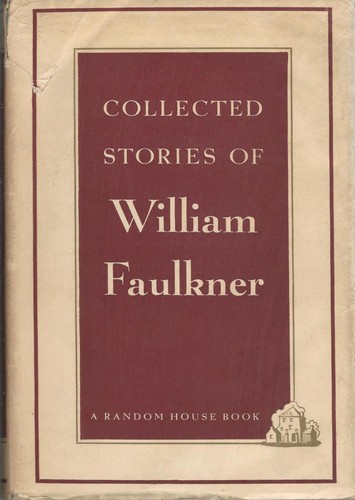
Collected Stories of William Faulkner
William Faulkner · 1897–1962 · USA
Why it matters
Forty-two stories spanning Faulkner's entire career, from Yoknapatawpha's founding families to war, horses, and menace, gathered into one landmark volume. Winner of the National Book Award, it remains the fullest map of Faulkner's mastery of short fiction.
At a glance
Faulkner's dense, experimental style varies story to story but never turns fully plain.
Deep dive
How Faulkner sorted forty-two stories, most of them nothing to do with Yoknapatawpha, into six titled sections that build a whole imagined geography rather than a chronology, and which two or three keep getting reread on their own.
Written for readers who have finished the book. No plot recap, and nothing here is safe to read first.
Themes & symbolism
Faulkner arranges the volume by imaginative territory rather than publication date: 'The Country,' 'The Village,' 'The Wilderness,' 'The Wasteland,' 'The Middle Ground,' and 'Beyond.' The first section opens with 'Barn Burning,' young Sarty Snopes torn between loyalty to his arsonist father Abner and a boy's dawning sense that some acts cannot be defended, a story that sets the volume's real argument: inherited obligation against individual conscience, tested again and again across very different settings.
'The Village' carries the book's two most anthologized pieces. 'A Rose for Emily' uses Jefferson's collective 'we' to narrate Emily Grierson's decades of isolation after her father's death and her lover Homer Barron's disappearance, the town's voice both gossiping about her and protecting her secret without ever quite admitting either. 'That Evening Sun' puts the Compson children, Quentin, Caddy, and Jason, at the edge of a horror they're too young to interpret: Nancy, the family's washerwoman, certain her husband Jesus means to kill her, waiting alone in her cabin while the children's father walks them home and leaves her there.
A Collective 'We' That Speaks for the Whole Town
The narrator of 'A Rose for Emily' never identifies as an individual, speaking instead as 'we,' the whole of Jefferson watching and half-protecting Emily across forty years. Faulkner uses that pooled, gossiping voice again in smaller doses throughout 'The Village,' training the reader to hear a town's collective judgment as its own kind of character, one with its own blind spots and its own complicity in what it lets Emily get away with.
What the Volume Deliberately Leaves Out
Faulkner excluded material already absorbed into his novels, most notably 'The Bear,' which belongs to Go Down, Moses, and the linked chapters of The Unvanquished. What remains here is the stray, uncollected half of his short career: war stories, ghost stories, horse-racing stories, work that never found a novel to live inside and had to make its case on its own, which is part of why the volume reads less like a sampler and more like Faulkner's own account of what didn't fit anywhere else.
Where to go next
 William Faulkner · 1929The Sound and the FuryLvl 10Slow burn
 William Faulkner · 1930As I Lay DyingLvl 9Medium pace
 William Faulkner · 1936Absalom, Absalom!Lvl 10Slow burn
 William Faulkner · 1954A FableLvl 9Slow burn
 William Faulkner · 1962The ReiversLvl 4Medium pace
 Cormac McCarthy · 1992All the Pretty HorsesLvl 6Medium pace